
Fast, no code setup
Increase sales on autopilot

Reward redemption rate is the percentage of issued rewards or points that members actually redeem within a defined period. It is a direct read on perceived reward value, program usability, and member engagement. A consistently low redemption rate signals friction, poor incentives, or weak visibility. A healthy rate indicates that members find rewards attainable and worth acting on, which typically correlates with higher repeat purchases and retention. In this guide you’ll learn how to calculate redemption rate, how to interpret averages and industry benchmarks, what drives low or high performance, and practical tactics you can use to increase redemption with a modern loyalty stack like Authic’s white-label platform.
How to calculate reward redemption rate
Use a clear numerator and denominator for your program type and a defined time window.
Redemption rate = Redeemed rewards or points within period / Issued rewards or points within same period x 100%
Tips:
Match time windows - if you issue points in Q1 and allow redemption in Q2, calculate the metric on a rolling basis or with cohorts.
Be consistent - choose either rewards count or points volume. For coupons, use redeemed codes vs issued codes.
Exclude test issues and voided rewards to avoid skew.
For deeper guidance on points balances, burn rate, and expiry, align your calculation window and policy with your program design.
Examples:
Scenario | Issued | Redeemed | Redemption rate
|
|---|---|---|---|
Points-based program | 100,000 points | 35,000 points | 35% |
Voucher-based reward | 2,000 vouchers | 420 vouchers | 21% |
Redemption rates by loyalty program type
Program design shapes expected redemption behavior and costs.
Points-based - typically mid-range redemption if thresholds feel attainable and earn rules are clear. Micro-rewards increase early redemption.
Tiered/VIP - redemption can be higher in upper tiers due to stronger perceived value and sunk-cost effects, lower in entry tiers if benefits feel distant.
Cashback/value-based - usually stable redemption patterns because value is transparent. Small balances can stall redemption without auto-apply.
Coalition/partnered - redemption depends on partner relevance and cross-channel visibility. Strong partner fit boosts redemption variety and rates.
Average redemption rate benchmarks
There is no universal “good” rate. Use your baseline, segment by cohort, and compare like-for-like campaigns. Directional ranges below can help you frame expectations.
Industry | Typical redemption range | Notes
|
|---|---|---|
Retail and e-commerce | 20% - 40% | Higher with low thresholds and auto-apply rewards at checkout. |
Food and beverage | 30% - 60% | High purchase frequency drives more frequent redemption. |
Travel and hospitality | 40% - 70% | High-value rewards motivate redemption, but longer cycles delay it. |
Health, wellness, beauty | 25% - 50% | Service frequency and appointment reminders matter. |
Financial services | 20% - 45% | Value transparency and easy redemption are critical. |
If you are below the lower bound for your industry, investigate reward relevance, friction, and awareness before adjusting financial value.
Factors behind a low redemption rate
Poor perceived value - rewards feel too small or generic compared to effort required.
High thresholds - members need too many points to unlock anything meaningful.
Short expiry windows - points and rewards lapse before members can act.
Complex flow - multiple steps, account logins, or offline-only redemption.
Low visibility - members forget balances without timely notifications.
Misaligned catalog - rewards do not fit member preferences or seasonality.
Low purchase frequency - redemption stalls without interim micro-rewards.
Data silos - POS and online systems are not synced, so balances are inaccurate.
Audit your reward types and redemption rules to address low perceived value, high thresholds, and catalog misalignment.
How to increase your redemption rate
Make rewards desirable and attainable
Offer a ladder of value - mix quick wins (low-point perks) with aspirational rewards.
Price rewards fairly - keep point-to-value conversion transparent and consistent.
Localize relevance - feature rewards that fit seasonality or location.
Reduce friction at every step
One-click or auto-apply - apply eligible rewards automatically at checkout or POS.
Universal redemption - allow in-app, online, and in-store redemption with one balance.
Clear UX - show balances, expiry, and eligible rewards on your home screen.
Add mobile wallet passes for easy redemption to minimize checkout friction and increase adoption.
Create more earn moments
Expand and clarify your point earning mechanisms so members progress faster toward rewards.
Reward beyond purchases - visits, bookings, referrals, reviews, and challenges.
Event-based bonuses - birthday perks, streak bonuses, double-point days.
Campaign rules - set specific earn multipliers with a campaign builder.
Personalize and segment
Segment by lifecycle - new, active, dormant, and VIP members see different offers.
Preference matching - recommend rewards aligned to category affinity.
Geo and time context - target rewards close to the next likely visit or purchase.
Drive visibility with timely reminders
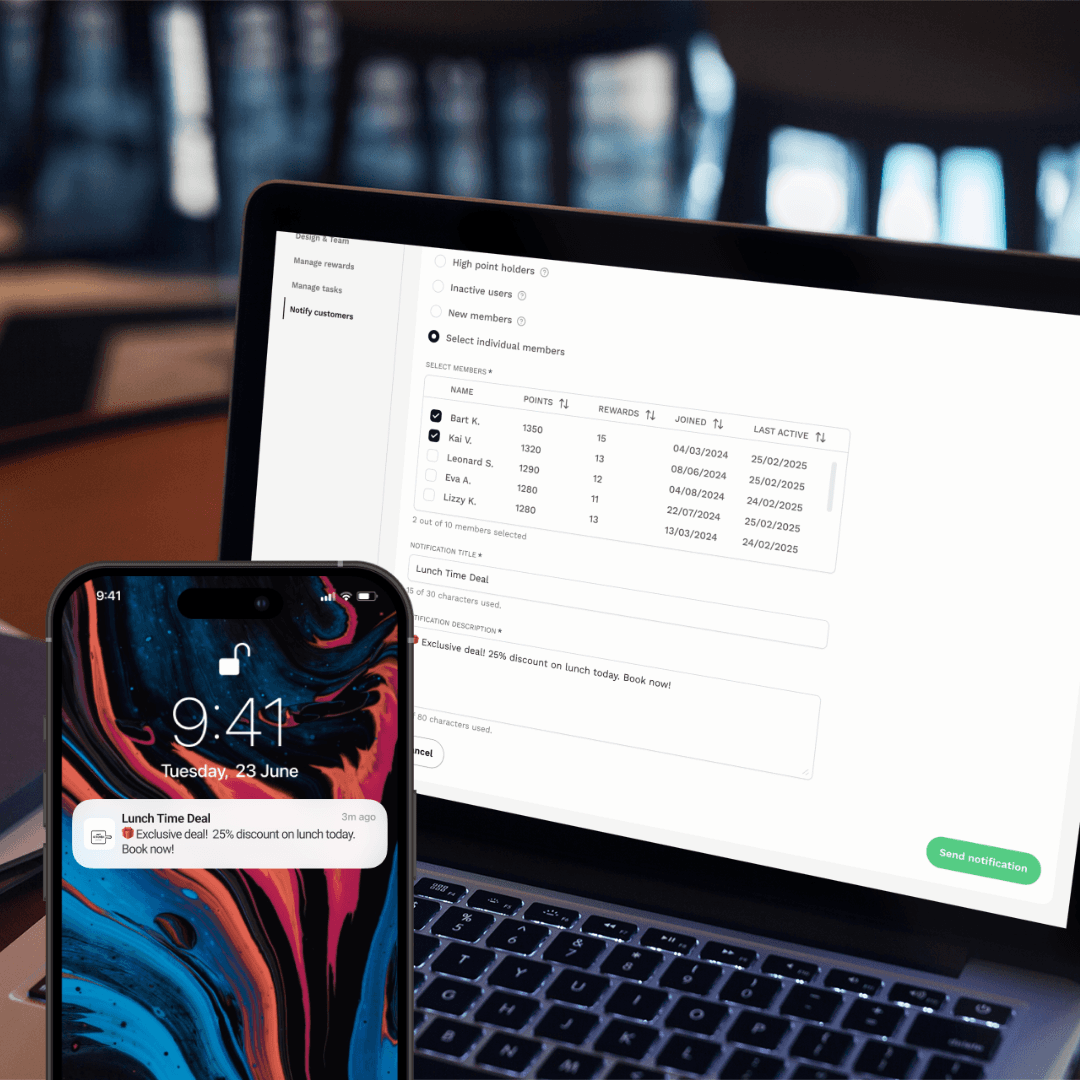
Set up redemption reminders and nudges to keep balances top of mind and prompt action.
Balance nudges - notify members when they cross a threshold for a reward.
Expiry alerts - 14-7-3 day countdown messages to prevent breakage.
Omnichannel - push notifications, email, and in-app messages reinforce action.
Use urgency ethically
Limited-time boosters - double points on targeted items for 48 hours.
Inventory-aware - highlight limited stock on high-demand rewards.
Clear end dates - state exact cutoff times to motivate action.
Add gamification and tiers carefully
Progress bars - show percentage to next reward or tier.
Streaks and challenges - reward consistent engagement over time.
Tier benefits - ensure every tier grants tangibly better rewards, not just status.
Optimize timing and expiry
Align with purchase cycles - trigger reminders near predicted repurchase dates.
Flexible expiry - lengthen windows for low-frequency categories.
Grace periods - offer small extensions for high-value members.
Measure and iterate
Run A-B tests - compare auto-apply vs manual redemption, or different thresholds.
Track cohorts - measure redemption by join month to see structural changes.
Monitor unit economics - ensure margin after reward cost stays healthy.
With Authic, you can configure earn rules via the campaign builder, surface balances and eligible rewards in a white-label app, and send automated notifications before expiry. The API helps unify online and POS balances so members can redeem anywhere without friction.
How redemption rate fits with other loyalty metrics
To link redemption to financial outcomes, learn to calculate loyalty ROI (including redemption rate).
Customer lifetime value (CLV)
Higher redemption rate often correlates with rising CLV when rewards steer more frequent or larger purchases. Watch net margin to ensure reward costs do not offset lifetime gains.
Customer retention rate (CRR)
Members who redeem are more likely to stay active. Track retention among redeemers vs non-redeemers to quantify impact and justify investment.
Average order value (AOV)
Smart thresholds can lift AOV - for example, unlock a reward at a slightly higher basket size. Avoid thresholds that drive returns or unnecessary purchases.
Engagement rate
Engagement covers opens, clicks, app visits, and reward views. Use it to diagnose awareness issues when redemption lags despite strong value.
Net Promoter Score (NPS)
Fair, easy-to-use rewards tend to lift NPS. Check NPS by redeemers vs non-redeemers to validate program experience quality.
Analyze and A-B test to optimize redemption
Set up consistent tracking before optimizing. Define your event taxonomy for issued, redeemed, expired, and voided rewards. Segment by channel, cohort, and tier.
Experiment design - test one change at a time: auto-apply, thresholds, expiry length, or reward catalog mix.
Primary metrics - redemption rate, breakage rate, AOV lift, margin after reward, repeat purchase rate.
Attribution - link redemption events to downstream revenue to separate pull-forward from true incremental sales.
Speed to learn - run shorter sprints on micro-rewards, longer windows for high-value redemptions.
Real-world snapshot: sports venue loyalty
In racket sports venues, players often earn points based on playtime and spend. When rewards are visible in-app and redeemable for gear or court-time discounts, redemption rises quickly after members cross their first threshold. Using Authic’s campaign builder and notifications, venues can award bonus points for off-peak bookings and nudge players before points expire, lifting redemption without eroding margins.
FAQs
What is the reward redemption rate?
It is the percentage of issued rewards or points that members redeem within a defined period. The metric reflects perceived value, usability, and engagement in your loyalty program.
How do you calculate redemption rate?
Divide redeemed rewards or points by issued rewards or points in the same time window, then multiply by 100. Keep the numerator and denominator consistent and exclude test or voided issues.
What is considered a good redemption rate?
It varies by industry and program design. Use your baseline, but as a rule of thumb, many retail and e-commerce programs see 20% - 40% when rewards are visible, attainable, and easy to redeem.
Which factors influence redemption rate?
Reward value, thresholds, expiry, friction in the redemption flow, visibility of balances, member purchase frequency, and catalog relevance are the biggest levers.
What is points breakage and should you reduce it?
Breakage is the share of issued points or rewards that expire unused. Some breakage is normal, but excessive breakage indicates friction or low value. Reducing it typically boosts retention and revenue.
Start improving your redemption rate with Authic
Launch a white-label loyalty app, configure campaigns in minutes, and drive timely reminders to lift redemption without extra ops work. Explore Authic’s campaign builder, notifications, and API integrations to unify online and in-store redemption and turn points into repeat customers.

Founder & CEO
Founder & CEO of Authic. Wouter helps businesses build lasting customer relationships through branded loyalty apps that drive engagement, repeat visits, and growth.

Continue reading



We provide the technology and simplicity to turn customers into loyal fans, without the complexity or cost of building it yourself.