
Fast, no code setup
Increase sales on autopilot

How to calculate loyalty program ROI
Here is a practical, finance-ready way to calculate loyalty program ROI. You will estimate incremental revenue instead of just member sales, include every cost line, choose the right time window, and validate impact with KPIs. Use the worked example to build your own model for hospitality, beauty, sports and clinics.
The ROI formula that actually works
Use this definition to reflect true business impact:
ROI = (Incremental profit from loyalty - Total program cost) / Total program cost x 100
Incremental profit from loyalty = Incremental revenue attributable to the program x Gross margin. Total program cost = Direct costs + Indirect costs over the same period. The key is isolating incremental revenue caused by the program, not simply revenue from members.
Step 1: Estimate incremental revenue, not just member sales
Incrementality answers the question: what would these customers have spent without the program. That requires a fair comparison so you do not over-credit the program.
Choose a measurement approach
A/B holdout test - Randomly withhold a statistically valid control group from the program and compare outcomes to the exposed group.
Matched cohort control - Match members to non-members on pre-join behavior, demographics and channel, then compare outcomes.
Pre-post with difference-in-differences - Compare the change from before to after enrollment against a similar group that did not enroll in the same period.
Track core sales drivers for each group over a defined window: average order value, purchase frequency, conversion rate, and visit count. Attribute only the lift vs control to the program.
You can Measure loyalty program ROI with analytics to isolate uplift, visualize cohorts and monitor KPIs.
Data you need
Transactions per customer - Orders, dates, items, channel.
Average order value - Net of VAT where relevant.
Purchase frequency and repeat rate - By cohort.
Gross margin - Product margin or blended margin for the mix members buy.
Member status and join date - To define exposed vs control windows.
Campaign exposures - To separate loyalty promotions from other marketing where possible.
Make sure your systems are connected—use a Loyalty API for connecting POS and CRM data so revenue, transaction and cost data feed your model accurately.
Worked example of incremental revenue
Suppose you evaluate 12 months after enrollment using a matched control:
Metric | Members | Matched control
|
|---|---|---|
Average order value | 35 | 30 |
Purchases per customer | 3.5 | 2.8 |
Revenue per customer | 122.5 | 84.0 |
Incremental revenue per customer | 38.5 | — |
Active members in period | 10,000 | — |
Incremental revenue = 38.5 x 10,000 = 385,000. If your blended gross margin is 60 percent, incremental profit = 231,000.
Step 2: Calculate total program cost
Total cost is more than rewards. Capture both direct and indirect lines, separating one-off setup from ongoing run costs.
Direct costs
Rewards and discounts - The real cost of points, coupons, free items, partner rewards and shipping on rewards.
Technology - Platform licensing, implementation, integrations, and front-end build for app or web.
Campaign funding - Budget for loyalty-specific promotions and limited-time boosters.
Benchmark platform, implementation and reward budgets using White-label loyalty software pricing and cost factors.
Indirect costs
People - Program managers, data analysts, CRM marketers, store staff training and support.
Operations - Customer service for points issues, fraud monitoring, stock for exclusive perks.
Compliance and accounting - Liability management for points, legal review of terms, data privacy.
Model points liability, breakage and earn/burn economics with Points mechanics (earn and burn rates).
One-off vs ongoing
Setup - Strategy, design, implementation and initial launch promotion. Amortize over the useful life or keep separate.
Run - Monthly tech fees, reward accrual and redemption, campaigns, people time and support.
To estimate cost-per-reward and margin impact, review Reward structure and redemption economics.
Step 3: Bring it together and compute ROI
Continuing the example, assume these costs for the same 12 months:
Rewards issued cost - 80,000
Technology and integrations - 30,000
People and operations - 25,000
Marketing and launch - 15,000
Total program cost - 150,000
Incremental profit = 231,000. ROI = (231,000 - 150,000) / 150,000 x 100 = 54 percent. That is the uplift attributable to the program after costs.
Run a sensitivity analysis - Vary margin and uplift assumptions within realistic bounds to see downside and upside scenarios.
Reconcile with finance - Align revenue recognition and liability treatment for rewards with your accounting policies.
Design experiments and targeted promotions to validate uplift—Run A/B tests and campaigns to validate ROI.
Validate with KPIs beyond ROI
ROI is a lagging indicator. Track leading KPIs to predict and tune ROI earlier.
Enrollment to activation rate - Active members with at least 1 earn or redeem action in 30 or 60 days divided by new sign-ups.
Redemption rate - Redeemed points or vouchers divided by issued. Too low can signal weak perceived value, too high can signal over-generosity.
Repeat customer rate - Customers with 2 or more purchases divided by all customers in a period.
Purchase frequency - Orders per customer per period. Useful for hospitality and sports where visits can be frequent.
Average order value - Track AOV of members vs matched non-members.
Customer lifetime value - Combine margin, frequency and retention probability to see long-term impact.
Choose the right time window
Loyalty ROI compounds over time and often needs a 12-14 month view. Calibrate by purchase cycle:
Hospitality - High frequency. You can see stable uplift in 3-6 months and confirm in 12 months.
Beauty and wellness - Medium frequency. Aim for 6-12 months to capture repeat bookings and cross-sell.
Sports clubs and venues - Session driven. Measure per season or 12 months to cover peak and off-peak.
Always align the ROI window with when major costs and rewards are incurred. If you front-load launch investment, expect ROI to rise as ongoing costs stabilize.
If ROI is low, use this diagnosis checklist
Enrollment quality - Are you enrolling the right customers and promoting at high-intent touchpoints.
Value design - Do rewards arrive fast enough. Reprice points, add small wins and experiential perks that cost little but feel premium.
Friction - Simplify earn and redeem. QR receipt sign-up, wallet passes, and auto-apply vouchers remove steps.
Segmentation and tiers - Offer progressive benefits for higher engagement. Trigger targeted boosters based on visit gaps or category interest.
Awareness and timing - Tie loyalty messaging into emails, POS, packaging and booking flows where decisions happen.
Liability and abuse - Tighten fraud rules and expirations while keeping the value fair.
Testing roadmap - Maintain control groups and A/B test offers, tiers and point pricing continuously.
Industry snapshots: hospitality and sports
Hospitality example: A restaurant introduces a tiered program with QR sign-up on receipts, visit stamps, referral bonuses and priority table access. After 6 months, members show higher visit frequency and AOV. By comparing to a matched non-member cohort, you attribute the lift, multiply by gross margin and evaluate ROI against rewards, tech, team and campaign costs.
Sports club example: A padel venue ties tiers to sessions played and offers off-peak boosters to fill spare capacity. Members book more sessions per month and introduce friends through referrals. A test-control model attributes the incremental court revenue and merchandise sales. You track redemption, activation, and churn to tune tier thresholds and reward economics.
How Authic Labs helps you measure and improve ROI
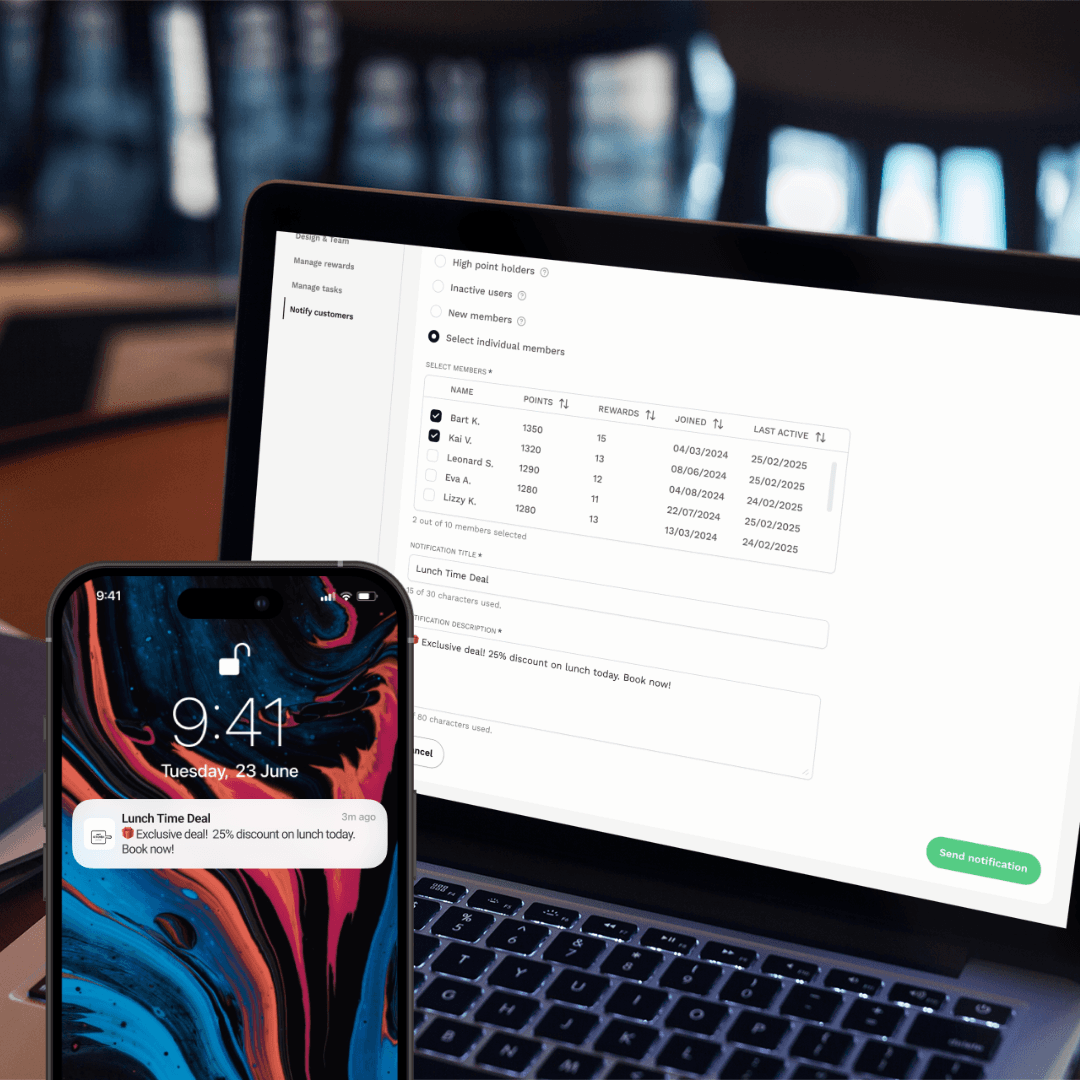
With Authic Labs you can launch fast and measure what matters. The white-label loyalty app lets you roll out branded earn and redeem experiences in minutes. The Campaign Builder gives you targeted boosters, tiers and referrals without code. The Loyalty API connects to your POS or booking system for real-time points and redemptions. Loyalty Analytics provides cohort, uplift and KPI tracking so you can isolate incremental revenue and optimize costs. Want help designing your ROI model and experiments. Book a demo to see what fits your stack.
FAQ
What is the ROI of a loyalty program?
It is the percentage return you get from your loyalty investment after all costs. Calculate it as incremental profit from loyalty divided by total program cost, then multiply by 100. Incremental means the lift vs a comparable non-loyalty baseline, not total member sales.
How to calculate ROI for a program?
1. Measure incremental revenue using a control group or pre-post with a matched cohort. 2. Multiply by gross margin to get incremental profit. 3. Sum all costs, direct and indirect, setup and ongoing. 4. Apply ROI = (Incremental profit - Total cost) / Total cost x 100. If you came here searching how to calculate loyalty program ROI or how to calculate loyalty program roi, follow the worked example above.
What is the 80 20 rule for loyal customers?
The 80 20 rule suggests a small share of customers often generates a large share of revenue. Use it to design tiers and focus benefits on high value segments, but validate with your own data because actual distributions vary by industry.
How do I calculate fundraising ROI?
Use the same structure. Incremental funds raised attributed to the initiative minus costs, divided by costs. Replace AOV and purchase frequency with average gift size and donor frequency, and use matched control or pre-post cohorts to isolate uplift.
How long should you measure before judging ROI?
Use at least one purchase cycle for your category and preferably 12-14 months to capture repeat behavior and full cost. For high-frequency categories you can make early reads at 3-6 months, then confirm at 12 months.
Ready to model your own ROI and test your uplift. Talk to Authic Labs to connect your data, set up cohorts and experiment with tiers, boosters and referrals.

Founder & CEO
Founder & CEO of Authic. Wouter helps businesses build lasting customer relationships through branded loyalty apps that drive engagement, repeat visits, and growth.

Continue reading



We provide the technology and simplicity to turn customers into loyal fans, without the complexity or cost of building it yourself.