ARTICLE
White Label Loyalty Platform vs Custom Built

Fast, no code setup
Increase sales on autopilot

If you are choosing between a white label loyalty platform and a custom built loyalty solution, the real question is not which option is better in general. It is which option fits your growth stage, budget, launch timeline, internal resources, and loyalty strategy. A white label loyalty platform helps you launch faster with lower risk and proven infrastructure. A custom built loyalty platform gives you full control, but usually demands more time, budget, and product ownership. This guide breaks down the trade-offs so you can make the right decision for your business.
How the decision changes your loyalty strategy
Your loyalty platform shapes far more than points and rewards. It affects how quickly you can go live, how easily you can test campaigns, how deeply you can integrate with your POS, booking flow, webshop, or CRM, and how much control you have over customer data and future development. That is why the choice between white label loyalty software and a custom built approach should be treated as a business decision, not just a technical one.
For many brands, speed matters. You may want to launch a branded loyalty app quickly, validate demand, improve retention, and start collecting first-party customer data without waiting months for development. In that case, a white label loyalty platform often makes sense. For businesses with highly specific workflows, unusual reward logic, or product requirements that cannot be handled through configuration and APIs, custom built loyalty software may be the better fit.
What is a white label loyalty platform?
A white label loyalty platform is a pre-built loyalty system that you can launch under your own brand. If you need a clearer explanation of what white-label loyalty software is, it helps to understand the model before comparing it with custom development. Instead of building the core technology from scratch, you use an existing platform and customize the branding, reward structure, campaigns, and selected integrations to match your business.
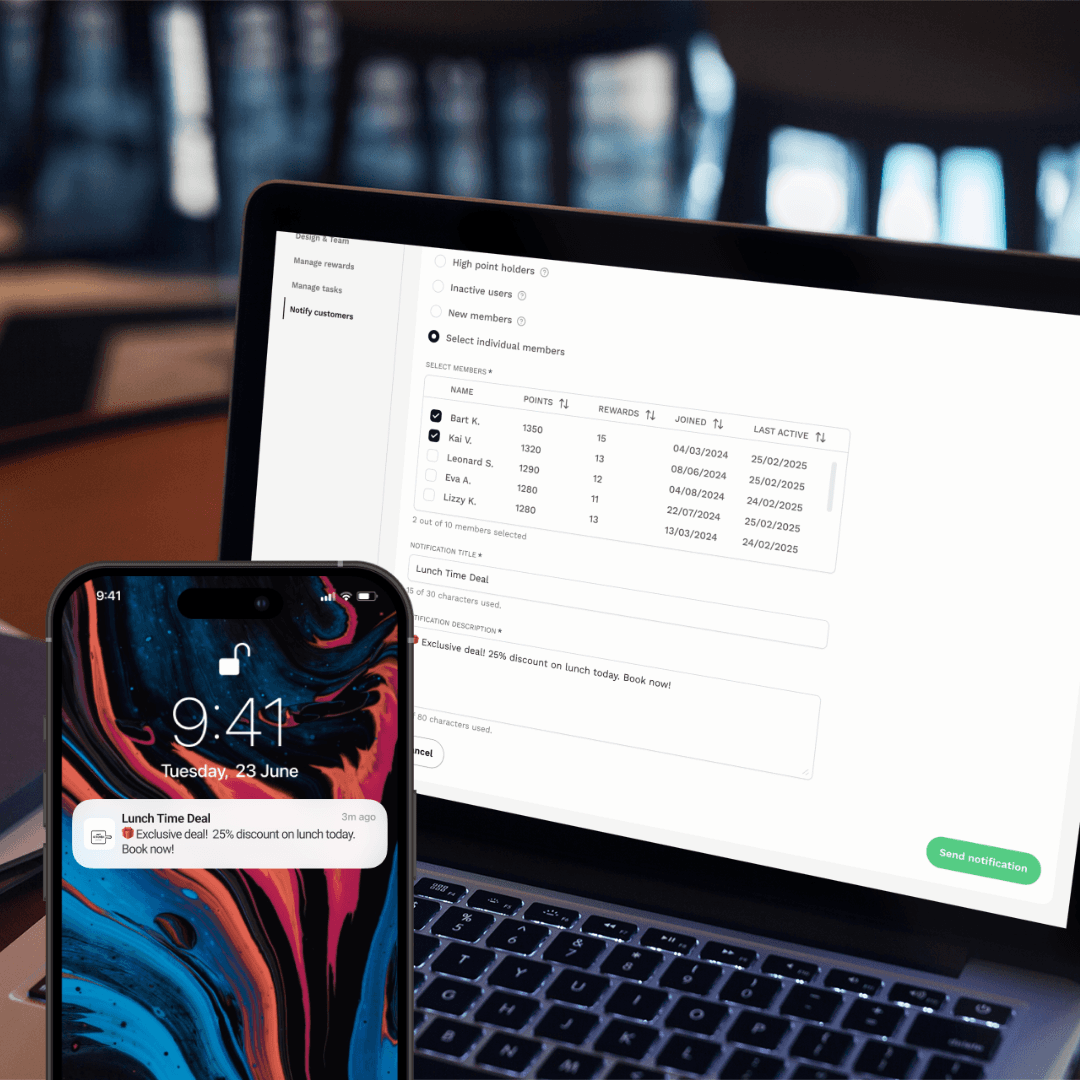
In practice, this often includes a branded customer app, loyalty rules such as points or tiers, campaign management, push notifications, analytics, and API connections with your existing stack. The biggest advantage is that the underlying software is already built, tested, and maintained, so you can focus on launch, adoption, and optimization rather than development from zero.
Faster time to market
Lower upfront investment
Predictable platform costs
Built-in loyalty features and reporting
Branding under your own business identity
Often suitable for app store launch under your own name
For businesses in hospitality, beauty, wellness, clinics, sports, and restaurants, this model is often attractive because it reduces technical complexity while still delivering a branded loyalty experience.
What is custom built loyalty software?
Custom built loyalty software is developed specifically for your business from the ground up. Instead of starting with an existing product, you define the architecture, customer journeys, reward logic, admin tools, integrations, and user experience based on your own requirements.
This approach gives you the highest level of control. You can create unique mechanics, own the roadmap, and design the platform around complex internal systems or industry-specific rules. But that freedom comes with trade-offs. A custom built loyalty platform usually requires a larger budget, a longer timeline, and ongoing technical ownership after launch.
Full control over product scope and roadmap
Custom workflows and logic from day one
Potentially deeper architecture control
More demanding implementation and maintenance
Higher delivery risk if scope changes during development
Custom build is usually most relevant when loyalty itself is a core product capability or when standard platform logic cannot support your operational model.
White label loyalty platform vs custom built: the core differences
Factor | White label loyalty platform | Custom built loyalty platform
|
|---|---|---|
Time to launch | Fast, often days to weeks | Usually months |
Upfront cost | Lower | Higher |
Ongoing maintenance | Handled largely by provider | Your team or development partner owns it |
Feature flexibility | High within platform limits | Very high, depends on budget and build scope |
Branding | Usually strong branding options | Fully custom |
Integrations | Often API-based and practical | Can be built exactly as required |
Risk profile | Lower implementation risk | Higher project and delivery risk |
Internal resources needed | Lower | Higher |
Best fit | Brands that want to launch and scale quickly | Businesses with highly unique requirements |
Cost comparison: which option is more cost-effective?
Cost is one of the biggest reasons businesses compare white label vs custom built loyalty software. The challenge is that many teams only look at initial spend, while the real decision should be based on total cost of ownership.
White label loyalty platform costs
White label loyalty software usually comes with a setup fee, subscription fee, or usage-based pricing. This makes it easier to budget, because the cost structure is clearer from the start. You also avoid the heavy upfront expense of product discovery, UX design, engineering, QA, release cycles, and infrastructure planning.
For many businesses, this is the most efficient route because you are paying for a proven system and ongoing platform support rather than funding a full product build yourself.
Custom built loyalty platform costs
Custom built software often includes discovery, product strategy, design, frontend and backend development, testing, DevOps, app deployment, bug fixing, security maintenance, and continuous updates. Even after launch, the platform still needs active ownership.
This means custom can become expensive not only during build, but also across the years that follow. It may still be the right choice if loyalty is strategically central to your business, but it is rarely the lower-cost option in the short term.
What total cost of ownership really includes
Initial setup or development cost
Maintenance and platform updates
Hosting and infrastructure
Security management
App store release and updates
Internal product and engineering time
Change requests and future feature development
Integration support
In many cases, a white label loyalty platform wins on short- to mid-term cost efficiency. If you want a deeper breakdown of pricing and cost factors, compare the recurring platform model with the long-term ownership demands of custom development.
Time to market: how fast do you need to launch?
Launch speed is often where the difference becomes most obvious. A white label loyalty platform is built for businesses that want to move quickly. If your goal is to launch a branded loyalty app, connect your existing systems, and start running campaigns without waiting through a long development cycle, white label has a clear advantage.
Custom built loyalty software takes longer because every core element must be planned, designed, tested, and refined. That is not automatically bad. If your business depends on unusual functionality, the extra time may be worth it. But if your real goal is to improve retention fast, validate a loyalty concept, or reduce churn this quarter, months of custom development can slow momentum.
For brands that want to skip 6 to 12 months of custom development and go live faster, a modern white label loyalty platform is usually the more practical choice. A practical implementation guide can help set realistic expectations for setup and launch.
Flexibility: configuration vs complete code control
One of the biggest misconceptions in this comparison is that white label means rigid and custom built means flexible. The reality is more nuanced.
A strong white label loyalty platform can still offer a lot of flexibility through configuration, campaign tools, branding, APIs, and modular features. That may already cover what most brands need, including points, tiers, referrals, VIP cards, rewards, check-ins, purchases, discounts, gifts, and personalized campaigns. Reviewing a platform features checklist can make these trade-offs easier to evaluate.
Custom built loyalty software gives you flexibility through code. That means you can create logic that does not exist yet, define unique admin flows, or build entirely different customer journeys. The trade-off is that every extra layer of flexibility must be designed, built, tested, and maintained.
The practical question is this: do you need unique functionality, or do you need strong functionality that can be adapted quickly? Many businesses discover that they do not need full custom development. They need branded loyalty software that fits their operations and connects well with the systems they already use.
Integrations and data ownership
Loyalty works best when it is not isolated. Your platform should connect to the rest of your customer ecosystem, such as POS, booking tools, ecommerce, CRM, or operational systems. That is why integrations are a critical part of the white label loyalty platform vs custom built decision.
Where white label platforms are often strong
Modern white label platforms often support integrations through APIs and existing connectors. This gives you a practical route to sync customer data, trigger rewards based on transactions, automate campaigns, and unify the loyalty experience across channels. If your use case is common and your systems are integration-friendly, this can be more than enough.
Where custom built can be stronger
If you need unusual data models, proprietary rules, highly specific event logic, or deep architecture-level control, custom built loyalty software offers more freedom. You can define exactly how the loyalty engine interacts with your stack and how data moves across systems.
Questions to ask before deciding
Do you need standard API-based integrations or custom-built system logic?
Will your loyalty program depend on real-time booking, transaction, or behavior data?
Do you need control over every data structure, or mainly access to usable customer insights?
Can your current systems work well with a platform approach?
For many businesses, especially those using established operational software, API-first white label loyalty software offers the right balance between speed and control.
Scalability and future growth
Scalability is often used as an argument for custom development, but that does not always reflect real business needs. A proven white label loyalty platform can already support significant growth, especially when the provider has built the platform to handle large user bases, campaign volume, and multi-location operations.
Custom built loyalty software can absolutely scale, but scalability is not automatic just because software is custom. It depends on architecture quality, engineering standards, hosting decisions, technical maintenance, and ongoing investment. If these are weak, custom software can become harder to scale than a mature platform.
If your business expects rapid rollout across locations, fast campaign experimentation, and a branded customer app without creating a full internal product team, white label often offers a more efficient path to scale.
Security, compliance, and operational risk
Security and compliance matter in both models, but the responsibility is distributed differently.
With a white label loyalty platform, part of the technical responsibility sits with the provider. That can be helpful because the platform is already maintained and updated, but it also means you should evaluate how the provider handles security, privacy, uptime, and data processing.
With custom built software, you control the architecture more directly, but you also carry more responsibility. Your team or partner must manage secure development, infrastructure, updates, access control, and long-term resilience.
Neither option is inherently safer in every scenario. The better choice depends on your internal maturity, risk profile, and regulatory demands. If your business operates in a tightly controlled environment with unique compliance logic, custom may be justified. If your requirements are strong but not highly unusual, a trusted platform can reduce operational burden significantly.
When a white label loyalty platform is the better choice
A white label loyalty platform is usually the best fit when speed, simplicity, and proven functionality matter more than building everything from zero.
You want to launch quickly with a branded loyalty experience
You want predictable costs instead of a large development project
You do not want to manage an in-house loyalty product team
Your required features are standard to advanced, but not highly unique
You need app-based loyalty, campaigns, analytics, and integrations without heavy development
You want to test and optimize your loyalty strategy before investing more deeply
This is often the right path for clinics, salons, restaurants, clubs, hospitality brands, and other customer-facing businesses that need retention tools fast and want them under their own brand.
When custom built loyalty software makes more sense
Custom build becomes more attractive when your business case goes beyond what a configurable platform can realistically support.
Your loyalty logic is deeply tied to proprietary processes
You need unusual workflows or reward mechanics that cannot be configured
Loyalty is a core competitive product feature, not just a retention tool
You have the budget and internal ownership to support ongoing development
You need full control over architecture, roadmap, and technical execution
Your compliance or integration requirements are highly specific
For most businesses, however, custom should be chosen for a clear strategic reason, not simply because it sounds more advanced.
A practical decision framework
If you are still deciding between white label loyalty software and custom built development, use these questions:
How fast do you need to launch?
Is loyalty a support function or a core product differentiator?
Can your goals be achieved with proven platform features and APIs?
Do you have internal technical resources for long-term ownership?
Are your requirements truly unique, or just important?
What matters more right now: speed, control, or uniqueness?
If your answers point toward fast implementation, lower risk, and strong branded functionality, a white label loyalty platform is likely the better fit. If they point toward highly custom logic and full product ownership, custom build may be justified.
Why many businesses choose a branded platform approach
In real-world loyalty programs, the winning approach is often not the most technically complex one. It is the one that gets adopted, used consistently, and improved over time. That is why many brands choose a white label loyalty platform with branded apps, configurable campaigns, analytics, and API integrations rather than delaying results through a large custom build.
For businesses evaluating providers like Authic, the appeal is clear: you can launch under your own brand, connect loyalty to your existing customer journey, manage campaigns without code, and scale without building the full loyalty infrastructure yourself. If you are at the vendor evaluation stage, this guide on how to choose a white-label provider is a useful next step.
FAQ
What is white label loyalty?
White label loyalty is a ready-made loyalty solution that a business can launch under its own brand. The provider supplies the core platform, while you customize the branding, rewards, campaigns, and selected integrations. It is commonly used to launch loyalty apps faster and with less development effort.
What is the downside of whitelabeling services?
The main downside is that you work within the limits of an existing platform. You may not get unlimited customization, full code ownership, or total freedom over product direction. That said, for many businesses, those trade-offs are acceptable because the speed, lower cost, and lower risk are more valuable than full custom control.
What is the difference between custom branding and white labeling?
Custom branding refers to making a product look and feel like your brand through logos, colors, messaging, and user experience elements. White labeling means the underlying product itself is provided by another company but offered under your brand. In short, custom branding is part of white labeling, but white labeling includes the software foundation as well.
Are white label loyalty platforms scalable?
Yes, many are. A mature white label loyalty platform can support growth across locations, user volume, campaigns, and customer segments. The key is to evaluate whether the platform can support your expected scale, integrations, and operational complexity over time.
What are the four types of loyalty programs?
The four common types are points-based programs, tiered loyalty programs, paid loyalty or membership programs, and value-based or behavior-driven programs. Many modern loyalty platforms combine these models, for example by using points plus VIP tiers and referral rewards in one program.
Is custom built loyalty software always better for enterprise brands?
No. Enterprise businesses do not automatically need a custom built loyalty platform. If a white label loyalty platform provides the required branding, integrations, analytics, and campaign flexibility, it can still be the better decision because it reduces delivery time and operational complexity.
Can you start with white label and move to custom later?
Yes, and for many businesses that is a smart path. Launching with white label allows you to validate your loyalty strategy, learn what customers engage with, and avoid overbuilding too early. If future needs become too specialized, you can then evaluate whether custom development is worth the investment.
How do I know if my requirements are truly custom?
A requirement is truly custom when it cannot be achieved through existing features, configuration, APIs, or practical workarounds. If your needs are mostly around branding, campaign control, customer journeys, points, tiers, referrals, app experience, and standard integrations, a strong white label platform may already cover them.

Founder & CEO
Founder & CEO of Authic. Wouter helps businesses build lasting customer relationships through branded loyalty apps that drive engagement, repeat visits, and growth.

Continue reading



We provide the technology and simplicity to turn customers into loyal fans, without the complexity or cost of building it yourself.