
Fast, no code setup
Increase sales on autopilot
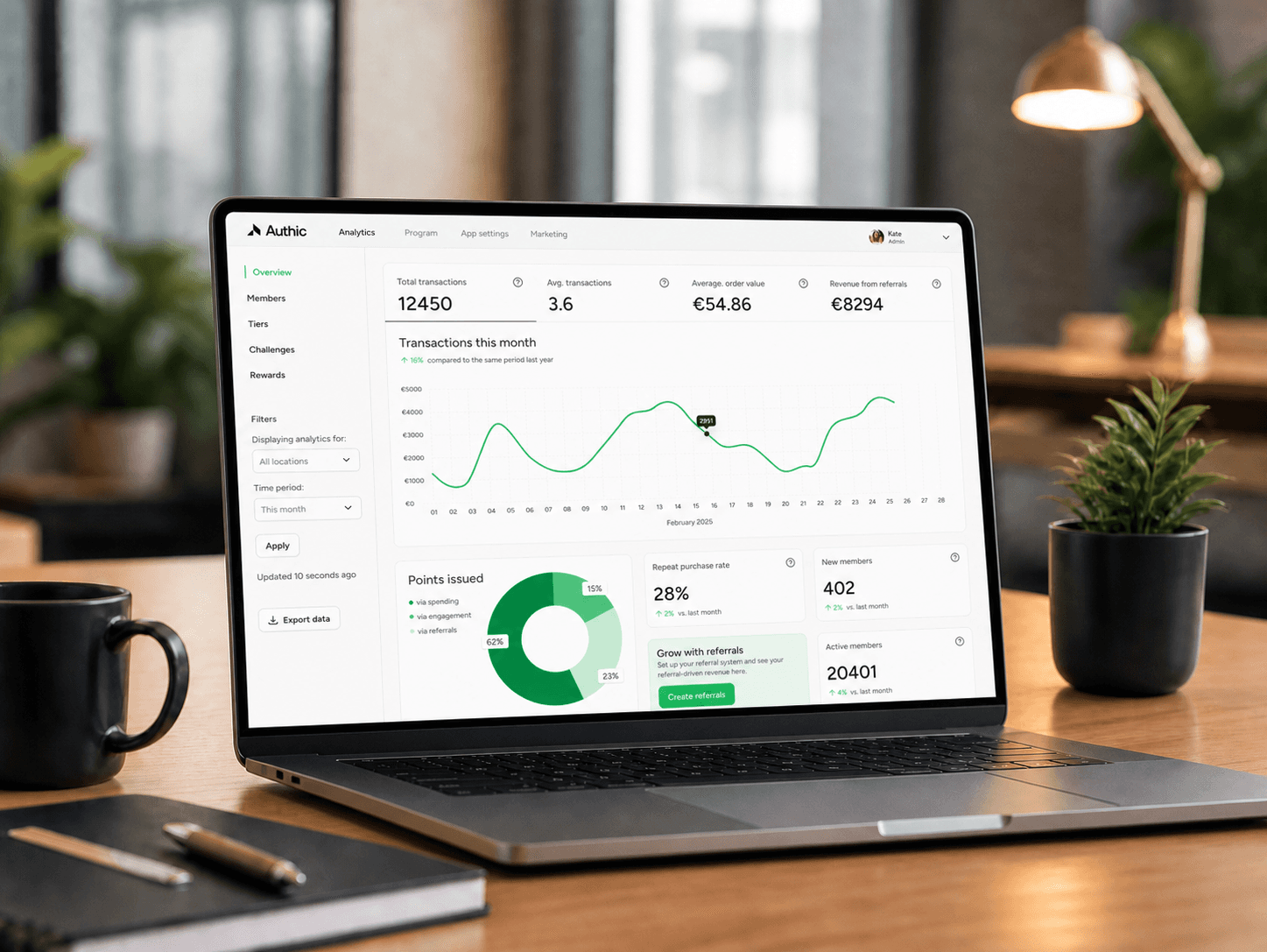
If you want loyalty to drive growth, you need a tight set of customer loyalty KPIs and metrics you can measure, compare and act on. The best loyalty program KPIs blend behavioral signals, emotional commitment and hard economics, so you can spot churn early, lift customer lifetime value and fund growth efficiently. This guide shows you exactly which KPIs for loyalty programs matter, how to calculate them, and how to use them to make smarter decisions in your loyalty dashboard.
A practical framework for loyalty KPIs
Strong KPI frameworks cover three lenses. Behavioral KPIs capture what members do across channels, from purchase frequency to offer redemption. Emotional KPIs reveal why they stay, tracking trust, satisfaction and advocacy so you can strengthen bonds, not just transactions. Economic KPIs prove value by quantifying incremental revenue, margin and lifetime value. For financial modeling and formulas, see calculate loyalty program ROI. When you connect these lenses, you can prioritize the next best action and allocate budget to the moments that truly move retention and profitability.
Measure and reduce churn
Churn is the share of customers who stop buying in a given period. Start by defining an inactivity window that fits your category. For beauty salons it could be 90 days, for sports clubs one membership cycle. Churn rate = churned customers in period divided by active customers at the start of period. The companion metric is retention rate = 1 minus churn rate. Watch early lifecycle churn closely, because the first and second purchase are where most drop-offs happen and where recovery is most cost-effective.
Use loyalty data to predict and prevent churn. Combine recency and frequency to flag at-risk members, then trigger win-back journeys with time-bound rewards, personalized recommendations and reminders about expiring points. Monitor uplift by segment, for example fashion versus general retail, because typical inactivity windows and reactivation tactics differ by sector. If you see churn trending up, test smaller but earlier incentives, improve onboarding communications and surface your highest utility rewards faster.
Model and grow CLV
Customer lifetime value shows how much profit a customer will generate over their relationship with you. A practical model is CLV = average order value x purchase frequency x gross margin x expected lifespan. Use cohort analysis to estimate lifespan and isolate incremental lift from the loyalty program. If you have subscription or membership fees, count net fee revenue and account for reward costs to calculate contribution margin per member. That starts with understanding the value of loyalty points.
To grow CLV, focus on the controllables. Increase purchase frequency with milestone bonuses and replenishment reminders. Raise average order value with personalized bundles and tiered rewards that unlock at higher baskets. Protect margin by steering members toward high-yield rewards and exclusive services instead of blanket discounts. Recalculate CLV quarterly and compare loyalty members to non-members to validate ROI. Over time, you should see a meaningful CLV lift among enrolled, engaged members versus a matched control group.
RFM segmentation to target loyalty actions
RFM stands for Recency, Frequency and Monetary value. Score each customer on a 1 to 5 scale for how recently they purchased, how often they buy and how much they spend. High RFM segments are your champions, low recency but high value are your sleepers, and low across the board are candidates for cost-controlled outreach. RFM is simple yet powerful because it compresses complex behaviors into segments you can act on immediately.
Put RFM to work in your loyalty program. Offer early access, experiential perks or referral boosts to champions to amplify advocacy. For at-risk high-value customers, combine a personalized offer with low-friction channels like SMS or app push to re-engage quickly. For newcomers with low frequency, use a welcome journey that accelerates time to second purchase. Refresh RFM scores weekly so campaigns always reflect the latest behavior and so you can attribute uplift by segment with confidence.
KPI quick wins you should not ignore
Customer engagement rate
Track the percentage of members who interact beyond purchases in a period, such as app logins, review submissions, referrals, social shares or participation in challenges. Engagement rate helps you see whether your program creates habits. Improve it with bite-size tasks, streaks and surprise-and-delight rewards that ladder up to meaningful milestones.
Offer redemption rate
Redemption rate = redemptions divided by issued offers. For definitions and tactics, dive into reward redemption rate. Low rates usually signal poor targeting, low perceived value or friction at checkout. Segment offers by RFM and channel, keep mechanics simple, and shorten expiry windows to create urgency. Monitor redemption margin by comparing the profit on redeemed baskets to a baseline so you reward without eroding economics.
Loyalty penetration and active member growth
Loyalty penetration = transactions by members divided by total transactions. It shows how embedded your program is in daily trade. Track active member growth by counting members with at least one qualifying action in the last 30 to 90 days. If penetration stalls, simplify enrollment, train staff and add in-journey prompts at POS and in your app to auto-enroll with consent.
Customer earned growth rate
Earned growth captures revenue from customers who come back and bring friends, as opposed to paid acquisition. Track new members sourced by referrals and organic channels, then measure their downstream CLV. A rising earned growth rate signals a healthier program that compounds through advocacy rather than spend-heavy promotions. For a concrete benchmark on advocacy-driven revenue, review referral revenue KPIs.
Average order value
AOV = revenue divided by number of orders. It is a straightforward lever that influences CLV. Lift AOV with personalized cross-sells, free shipping thresholds and tier multipliers that award more points or perks at higher baskets. Watch gross margin alongside AOV to avoid trading profit for volume.
Emotional KPIs that turn customers into advocates
Transactional metrics tell you what happened. Emotional metrics explain why it happened and whether it will keep happening. Measure satisfaction with post-purchase or post-visit surveys, trust with statements like I believe this brand will make it right and attachment with prompts about how disappointed a member would be if the program went away. Track advocacy through referral intent and actual referral rate, not only an abstract promoter score.
Why it matters. Members with high emotional loyalty typically spend more, redeem more efficiently, forgive the occasional misstep and are far more likely to refer. Make emotions actionable by linking scores to behaviors. For example, members with high trust but low activity might respond to exclusive previews, while those with high satisfaction but low attachment may need identity-based rewards like access to events or communities.
Operational tips. Keep surveys short and contextual, use app prompts to boost response rates, and tag responses to member IDs so you can correlate emotion with RFM and CLV. Build a simple dashboard tile that trends trust, satisfaction and advocacy over time and highlights segments where emotion and behavior diverge. Then assign next best actions that close the gap, such as service recovery outreach for low-trust high-value members or referral prompts for high-attachment champions.
From metrics to action with Authic
Authic’s Loyalty Analytics gives you real-time visibility into the KPIs that matter, including member counts, visit frequency, spend per visit and reward redemptions. You can segment by RFM, monitor churn risk, and see the impact of each campaign on CLV and margin so you fund what works and fix what does not. In beauty, DNA Beauty reached an 83 percent repeat-visit rate in 5 months by combining targeted rewards with timely reminders. Read the repeat visit rate case study. In sports, Peakz Padel strengthened retention and increased referrals by rewarding member advocacy. If you want the same clarity, connect your data to Authic and turn your loyalty program into a growth engine.
FAQs
Which KPI measures customer loyalty best?
No single KPI captures loyalty fully. Use a bundle led by CLV and churn for economics, RFM and engagement for behavior, and trust or advocacy for emotion. Together they predict growth and guide action. If you want the concise take, see our guide to the customer loyalty KPI.
What are the 3 R's of customer loyalty?
Recency, Frequency and monetary value. RFM helps you segment customers quickly and match rewards and communications to their current behavior.
What are the 4 C's of customer loyalty?
Commonly convenience, consistency, connection and community. Map them to KPIs by tracking frictionless access, reliable service quality, emotional attachment and referral or participation in member-only spaces.
What should a loyalty program KPI dashboard include?
At minimum show CLV and churn trends, RFM distributions, engagement and redemption rates, loyalty penetration, and emotional scores tied to segments. Add campaign-level ROI so you can double down on what works.

Founder & CEO
Founder & CEO of Authic. Wouter helps businesses build lasting customer relationships through branded loyalty apps that drive engagement, repeat visits, and growth.

Continue reading



We provide the technology and simplicity to turn customers into loyal fans, without the complexity or cost of building it yourself.