
Fast, no code setup
Increase sales on autopilot
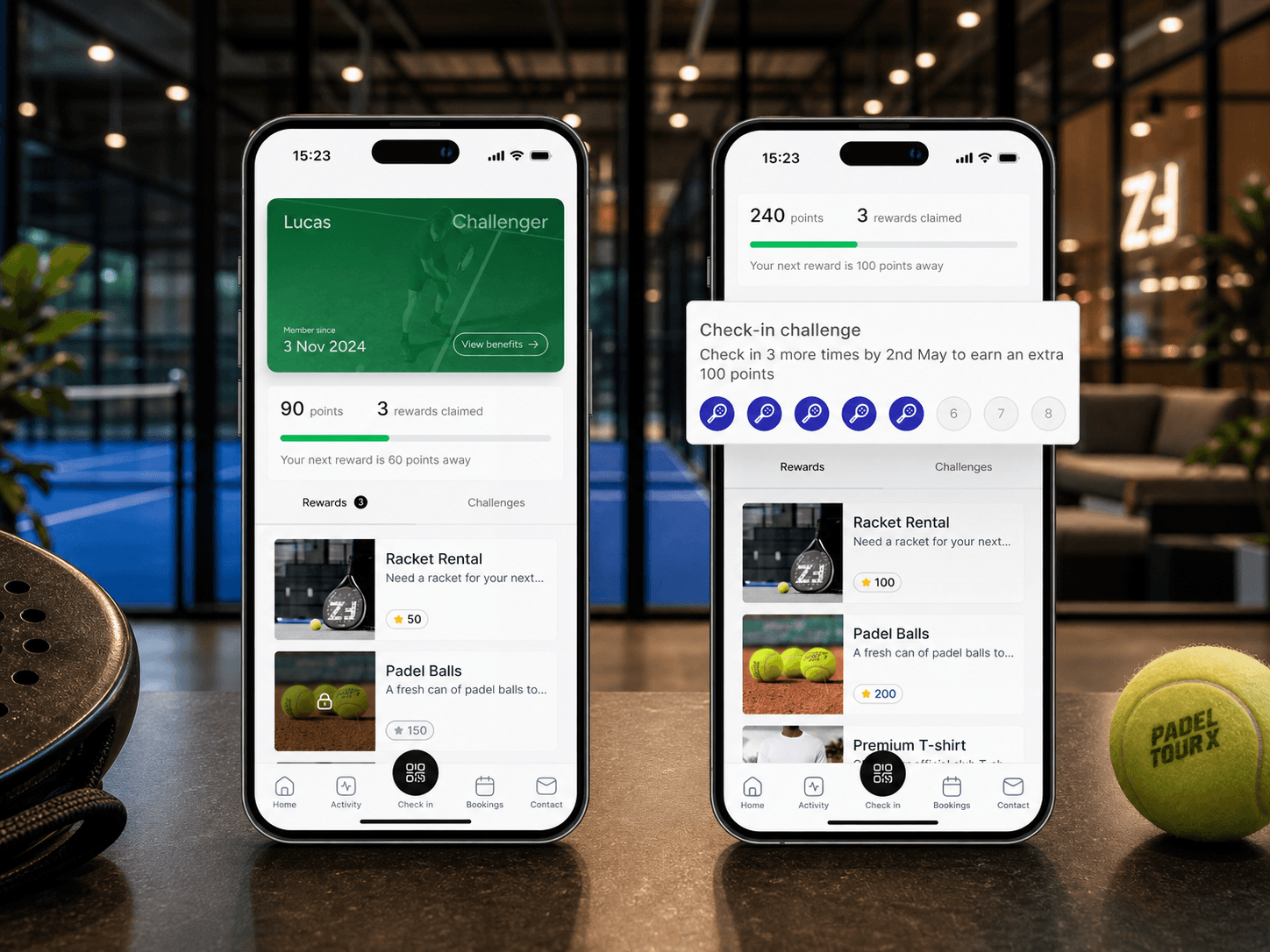
Choosing between a points-based program and a punch card loyalty program can change how often players book, what they spend on-site, and how easily you fill off-peak courts. This guide gives you a clear, practical comparison so you can decide fast, launch smoothly, and measure impact confidently.
How each model works in a padel club
A points-based program rewards multiple behaviors. Players earn points for court bookings, pro-shop purchases, lessons, events, or referrals, then redeem for rewards like free court time, discounts, or exclusive access. Points let you steer behavior precisely: bonus points for off-peak bookings, extra for higher-margin items, or tiers that unlock perks for your best players. Because every event has a value, you can automate earning, track redemption, and personalize offers.
A punch card (stamp card), also called a loyalty punch card, is simpler. Players collect a stamp after each qualifying action, usually a paid booking or purchase, and receive a fixed reward after N stamps, such as the 10th hour free. It is easy to explain and quick to launch. Punch cards shine when your main revenue is a single, repeated action and you want a straightforward path to a freebie.
When a points-based program outperforms
Choose points when you want flexibility, data, and precision. Points let you reward diverse behaviors beyond bookings, tailor bonuses to off-peak hours, and create tiers for VIP players without changing your pricing. If you run multiple revenue streams like coaching, events, shop sales, or food and beverage, points-based loyalty can lift average revenue per user and cross-sell. It also gives you granular insights: who earns, who redeems, and which incentives move the needle. If you plan to test, iterate, and scale, points give you the most control.
When a punch card wins
Pick a punch card when you want zero-friction loyalty that players grasp in seconds. If your club mainly sells pay-as-you-play court time and you value a simple promise like play 9, get the 10th free, a punch card keeps operations light and the message clear. It is also a solid fit for new clubs validating demand, or for satellite locations where staff change frequently and training time is limited. If your systems are not yet integrated, a digital punch card is a fast path to more repeat visits without complexity.
Points vs punch card: side-by-side
Criteria | Points-based | Punch card
|
|---|---|---|
Value proposition | Earn points on many actions, redeem for varied rewards | Collect stamps, get a fixed reward after N visits |
Ideal club profile | Multi-revenue clubs seeking upsell and behavior shaping | Single-core action clubs prioritizing repeat bookings |
Setup and ops | Requires rule design and integration, still fast with no-code tools | Very quick to launch, minimal training |
User experience | More options, stronger perceived value | Ultra simple, easy to explain at the desk |
Off-peak control | High - bonus points, time-based boosts | Medium - can offer double stamps off-peak |
Fraud risk | Lower with automated tracking and unique rules | Higher if manual; use digital validation to reduce risk |
Data capture | Rich - earns insight across journeys | Basic - tracks visits or purchases |
Cost to club | Variable and optimizable via point values | Fixed reward liability per N actions |
Upsell potential | High - reward bundles, tiers, targeted offers | Low to medium - mainly repeat visits |
Business impact and KPIs to track
Beyond gut feel, measure outcomes. Track retention rate and repeat booking frequency to see whether players stay longer and play more often. Monitor ARPU to check if points or stamps lift secondary spend on lessons or the shop. Use off-peak occupancy to confirm that incentives shift demand to quieter hours. Keep an eye on reward redemption rate and breakage to balance perceived value with cost. For profitability, watch gross margin on redemptions by tying point values or stamp rules to higher-margin items or time slots. If you run tiers or referrals, track tier progression and referral activations to quantify long-term lift.
Implementation playbook: launch in 48 hours
Day 0 - choose your mechanism. If you have multiple revenue streams or want off-peak control, go points. If your goal is simple repeat play with minimal ops, go punch card. If you are also weighing subscriptions, see Points vs subscription models for padel clubs.
Define rules players will love and staff can explain. For points, set a base earn rate per euro or per hour, plus 2 to 3 simple bonuses like off-peak multipliers and event participation. For punch cards, pick a clean structure like 1 stamp per booked hour, reward on the 10th stamp, and block stamps on already discounted slots if needed.
Connect systems. Link booking and POS to your loyalty app so earning is automatic. If full integration is not ready, start with a digital card or QR validation and add automations later.
Prepare rewards and liability limits. Offer a mix of fast, mid, and aspirational rewards. Cap monthly redemptions for scarce perks, and align reward cost with margin. Publish clear terms to avoid confusion.
Train staff and launch comms. Give your front desk a 60-second script and a one-page FAQ. Announce in-app, on your website, in email, and on-court signage. Keep the message simple: here is how you earn, here is why it is valuable, here is how you redeem.
Iterate in week 1. Watch enrollment, first earn, and first redemption rates. If signups lag, simplify the message. If redemptions are too slow, reduce thresholds slightly or add a quick-win reward. If off-peak is still soft, increase the bonus only for specific hours.
Advanced loyalty tactics that multiply results
Use time-based boosts: double points or double stamps for weekday mornings to lift off-peak occupancy without discounting list price. Run short seasonal campaigns with bonus rewards tied to tournaments or club events. Add referral rewards to bring in new players and keep acquisition cost low. Layer tiers later, giving consistent players small guaranteed perks like priority booking windows or free grips, without complicating the base program. For more engagement ideas, see Gamifying your padel loyalty program.
Risks and how to avoid them
Overly complex rules reduce adoption. Keep to a few earn rules and a clear reward ladder. Poor economics can erode margin. Model cost per point or per stamp and align with your average booking value and capacity. Manual processes invite errors and abuse. Use digital validation and system integrations to automate earning and redemption. Misaligned incentives lead to peak-time crowding. Steer demand with off-peak bonuses and limit peak-time redemptions where needed.
Case spotlight: Peakz Padel
Peakz Padel launched a loyalty program with Authic where players earn for playing and club activities, redeeming for exclusive perks and merchandise. The program gave Peakz flexible controls to promote events, strengthen habits beyond pure court time, and celebrate consistent players. With a white-label experience and guided onboarding, setup was fast and the team could iterate rewards based on real usage data.
FAQs
Is a punch card a loyalty program?
Yes. A punch card, or stamp card, is a simple loyalty mechanic that rewards a fixed action after N repeats, like the 10th booking free. It works best when your primary goal is repeat visits with minimal operational overhead.
How do loyalty punch cards work?
Players receive a digital stamp after each qualifying booking or purchase. After a set number of stamps, they unlock a predefined reward. Good punch cards include clear rules, digital validation to avoid errors, and simple redemption at the desk or in-app.
What are the disadvantages of loyalty cards?
Traditional punch cards can be inflexible, easier to game if manual, and offer limited data compared to points. They also focus mainly on one behavior, which can limit upsell and cross-sell opportunities unless you add variations like double stamps for off-peak slots.
Do loyalty cards really work?
They do when the reward is clear, the path to earn is short, and validation is seamless. For broader behavior change and deeper insights, points-based programs typically outperform, but a well-designed punch card can reliably drive repeat bookings.
Launch a loyalty program under your own brand
Authic gives padel clubs a white-label loyalty app that supports both points-based and punch card models. You can reward bookings, shop purchases, lessons, and events, set off-peak incentives, and manage rewards in a clean dashboard. Most clubs launch in 48 hours with guided onboarding and best-practice templates. If you are unsure which model fits, we will help you model costs, forecast impact, and start simple so you see results fast.

Founder & CEO
Founder & CEO of Authic. Wouter helps businesses build lasting customer relationships through branded loyalty apps that drive engagement, repeat visits, and growth.

Continue reading



We provide the technology and simplicity to turn customers into loyal fans, without the complexity or cost of building it yourself.