Fast, no code setup
Increase sales on autopilot

Padel club loyalty improves when players have more reasons to come back than just court availability. The clubs that retain members best create habits, reward participation, make every visit feel connected, and remove friction from booking, events, coaching, and in-club spending. If you want more repeat visits, stronger community ties, better off-peak usage, and lower churn, you need a loyalty strategy built around player behavior, not generic discounts.
For padel clubs, that usually means combining community-first experiences with structured rewards for bookings, check-ins, lessons, referrals, event participation, and purchases. The goal is simple: turn casual players into regulars, regulars into advocates, and advocates into long-term revenue for the club.
Why padel club loyalty matters more than most clubs think
A loyal player is worth far more than a single court booking. When someone plays regularly at your club, they are more likely to book recurring slots, join events, take coaching, bring friends, spend at the bar or pro shop, and recommend your club to others. That makes loyalty one of the clearest growth levers for any padel operator.
The opposite is costly. When players keep switching between clubs based on convenience or price, revenue becomes unpredictable and your community stays weak. You do not just lose one booking, you lose all the follow-on value attached to that player over time. That is why strategies to improve padel club loyalty should focus on both retention and participation depth.
Higher repeat booking frequency
Stronger membership renewal rates
Better off-peak court utilization
More event participation and referrals
Higher in-club spend across coaching, bar, and shop
What makes a good padel club from a loyalty perspective
If you ask what makes a good padel club, the answer goes beyond quality courts. Players stay loyal to clubs that feel easy to use, welcoming to all levels, and active enough to create momentum. Great clubs reduce barriers for beginners, give regular players recognition, and make it simple to find the next reason to return.
A good padel club usually combines operational quality with emotional connection. That means reliable booking, good coaching, friendly staff, strong event programming, and a sense that the club notices and values participation. Loyalty grows when players feel progress, belonging, and convenience at the same time.
The core ingredients of a loyalty-driven club experience
Consistent court and facility quality
Simple booking and check-in flows
Beginner-friendly onboarding and social play options
Visible rewards for repeat behavior
Events that create connection beyond gameplay
Coaching pathways for improvement and progression
Personalized communication based on player activity
Build loyalty around behavior, not around discounts
One of the most effective strategies to improve padel club loyalty is to reward the actions that make your club stronger. Many clubs default to occasional promotions, but one-off discounts rarely change long-term behavior. They can drive a short spike in activity, yet they do little to build routine or attachment.
A stronger model is behavior-based loyalty. Instead of only lowering price, you reward the actions you want more of: repeat bookings, weekly play streaks, lesson attendance, event participation, referrals, off-peak play, and purchases inside the club. This creates a system where players understand how to progress and why staying active benefits them.
This is also where digital loyalty becomes more effective than paper stamp cards. If progress updates, rewards, and reminders appear automatically through your own club app or digital wallet experience, participation feels immediate and easy to follow.
Create a community-first loyalty strategy
Padel is naturally social, which makes community one of the strongest retention drivers available to a club. Players often stay loyal because they know people, join recurring groups, attend themed events, and feel part of something bigger than court rental. A loyalty strategy should strengthen that dynamic rather than operate separately from it.
Community-first loyalty works best when rewards support social behavior. That can mean giving points for joining club events, unlocking early access to mixers, rewarding referrals, recognizing weekly participation, or creating member-only challenges. These mechanics make loyalty visible in the moments where club culture is built.
For clubs with families, mixed skill levels, or a broad player base, segmenting community activities also helps. Beginners need low-pressure entry points. Regular players want recognition and rhythm. Competitive players may respond better to ladders, leaderboards, and exclusive match formats. The more your loyalty setup reflects real player motivation, the better your retention usually becomes.
Community tactics that increase repeat engagement
Beginner mixers with low-pressure introductions
Weekly round robins and social ladders
Member-only events or priority event access
Referral challenges that reward both players
Seasonal club competitions with progress tracking
Family-friendly events for broader household engagement
Use tiered loyalty to make progress visible
A tiered loyalty program is one of the most practical ways to improve padel club loyalty because it gives players a clear sense of progress. Instead of collecting points with no real meaning, players move through visible levels based on their activity. That status element matters in a sport where routine, identity, and social recognition play a big role.
For padel clubs, tiers can be based on court bookings, spend, check-ins, lesson frequency, referrals, or a combination of these. A player might move from Bronze to Silver to Gold by hitting certain activity thresholds over a rolling time period. In return, they receive benefits that improve the club experience rather than generic rewards with low perceived value.
Strong tier benefits often include priority booking, event access, coaching perks, guest passes, off-peak credits, or in-club rewards. The key is to keep the structure easy to understand. Most clubs do better with three or four tiers, one primary route to progress, and benefits that feel attainable and useful. A tiered loyalty structure can help clubs turn this approach into something players immediately understand.
Rewards that usually work well in padel
Priority access to popular time slots
Discounts or credits for off-peak bookings
Exclusive entry to tournaments, mixers, or clinics
Coaching vouchers or lesson bundles
Bar or pro shop credit
Guest passes and referral bonuses
Choose the right loyalty model for your club
Not every club should run the same program. The best reward structure depends on your business model, player mix, and operational goals. A club focused on utilization may prioritize off-peak incentives. A club with strong coaching revenue may reward lesson attendance. A community-led venue may place more value on events and referrals. If you are comparing points or subscription-based loyalty, the right fit usually depends on what behaviors you want to reinforce most.
Court-time loyalty
This model rewards players based on how often they book and play. It is effective when your main goal is increasing repeat visits and keeping players active over time. It is simple to communicate and easy for players to understand.
Spend-based loyalty
This works well if your club earns meaningful revenue from coaching, food and beverage, retail, or extras around the court booking. Players progress based on total spend, and rewards can encourage more share of wallet inside the club.
Streak-based loyalty
Streak mechanics are useful when you want to build habits. Rewarding players for consecutive active weeks can be powerful for onboarding new members and preventing drop-off after the first few sessions.
Community and referral loyalty
If word of mouth is a major growth driver, reward players for bringing friends, joining events, and contributing to club activity. This type of structure supports organic growth and stronger social bonds.
Coaching-led loyalty
For clubs with a strong lesson offer, loyalty can be tied to coaching participation, progression pathways, and skill-based challenges. This creates a clear link between improvement and retention.
Make onboarding easy for new and casual players
Many loyalty problems start before a player ever becomes loyal. New players often like padel but do not yet have a regular group, preferred schedule, or confidence level. If the first few visits feel unclear or disconnected, they can quickly become occasional users who drift away.
That is why one of the smartest strategies to improve padel club loyalty is to design the first month carefully. Intro lessons, starter challenges, beginner events, and simple first rewards help new players form a habit before they start comparing alternatives. The faster you move someone from first booking to second, third, and fourth visit, the better your retention base becomes.
What to include in a strong first-month journey
A welcome reward after the first booking or check-in
A beginner clinic or introduction event
A streak challenge for the first 30 days
Suggestions for matching with players of a similar level
Automated reminders to book the next session
A referral incentive once the player has had a positive first experience
Improve loyalty with coaching, events, and club rhythm
Clubs often underestimate how much rhythm influences loyalty. Players are far more likely to stay active when your club gives them recurring moments to return to. Coaching schedules, social leagues, club nights, ladders, and seasonal tournaments all create this rhythm.
Coaching is especially valuable because it increases both commitment and progress. A player who is improving usually has more motivation to keep playing. Events matter for a different reason: they build emotional attachment and deepen the social side of the club. When coaching and events are linked to rewards, loyalty becomes part of the overall club journey rather than a separate marketing layer.
Use off-peak incentives to drive both loyalty and utilization
One of the most commercially useful loyalty tactics is rewarding behavior that improves court occupancy. If your club has underused slots during certain hours, loyalty incentives can help fill them without relying on broad discounting. This improves utilization while also giving players an extra reason to stay engaged.
Examples include bonus points for off-peak bookings, special challenges for quieter days, or tier perks that unlock favorable rates during low-demand windows. This works particularly well when communicated automatically through notifications based on player history and booking behavior.
Personalize communication with data from bookings, check-ins, and purchases
Loyalty programs become much more effective when communication is based on real behavior. A player who books twice a week needs a different message from someone who has not visited in three weeks. A beginner who attended one intro lesson should not receive the same campaign as a highly active tournament player.
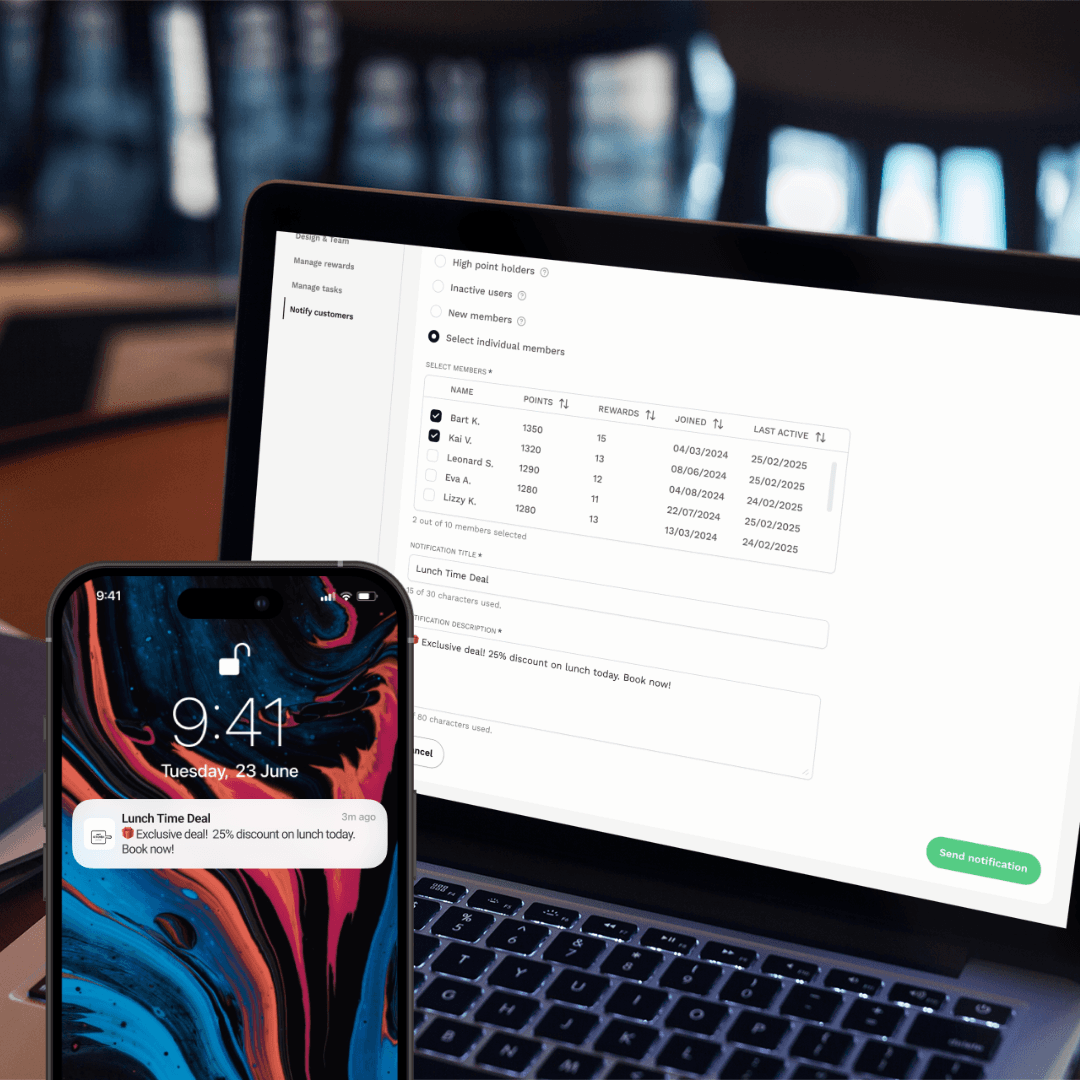
This is where integrated loyalty setups create an advantage. When your loyalty program connects with booking systems and POS data, you can trigger relevant campaigns automatically. For example, you can send a win-back reward after inactivity, recognize a booking milestone, reward event participation, or push an off-peak offer to a player who usually books at busy times.
For operators, this turns loyalty into an ongoing system rather than a series of manual campaigns. For players, it makes the club feel more responsive and relevant.
Useful automated loyalty triggers for padel clubs
First booking completed
Three visits in 14 days
No activity for 21 or 30 days
Completed lesson package
Joined a club event
Booked an off-peak slot
Referred a new player
Reached a new tier
Digital loyalty works better when it fits existing club behavior
Players do not want another system that feels separate from the club experience. The best loyalty setups are embedded into behavior they already have: booking courts, checking in, paying at the bar, joining events, and using their phone. That is why clubs increasingly prefer digital loyalty formats that can sit inside a branded app or connect through Apple Wallet, Google Wallet, booking flows, and POS integrations.
The practical benefit is simplicity. Players can see progress, rewards, and status without changing how they already interact with the club. Club staff also avoid manual work, because rewards and notifications can be triggered automatically. For operators, that means faster rollout and more consistent execution.
For a platform like Authic, this is where white-label loyalty becomes especially relevant: clubs can launch branded loyalty mechanics, no-code campaigns, membership tiers, VIP cards, challenges, and analytics without having to build a custom system from scratch.
Measure the right loyalty KPIs
If you want to know whether your loyalty strategy is working, track behavior change rather than only sign-up volume. A large number of enrolled players means very little if activity does not increase. The best loyalty KPIs show whether players are visiting more often, staying longer, and contributing more value over time.
Key padel club loyalty metrics to monitor
KPI | Why it matters
|
|---|---|
Repeat visit rate | Shows whether players are returning consistently after their first sessions |
Weekly active players | Measures ongoing engagement across your club base |
Court utilization | Indicates whether loyalty is helping fill more playable hours |
Average visits per member | Shows how deeply members are using the club |
Referral rate | Measures whether loyal players are bringing in new players |
Lesson participation | Useful when coaching is part of your retention strategy |
In-club spend per active player | Shows broader commercial impact across bar, shop, and services |
Churn or inactivity rate | Helps identify whether players are dropping off despite enrollment |
Common mistakes that weaken padel loyalty programs
Many clubs introduce loyalty with the right intention but poor execution. The result is a program that exists on paper without changing behavior. Usually the issue is not the idea of loyalty itself, but the fact that the structure is too complicated, too generic, or too disconnected from how players actually use the club.
Too many rules and unclear reward logic
Benefits that do not feel valuable to players
Overreliance on price discounts instead of experience perks
No connection to bookings, events, coaching, or referrals
No visibility into progress or tier status
No automated win-back or reactivation flow
Tracking sign-ups instead of behavior change
How to launch a padel club loyalty strategy without overcomplicating it
You do not need a highly complex setup to get results. In most cases, a simple program launched well performs better than an advanced model launched too late. Start with one core behavior you want to grow, such as repeat bookings, and build from there.
A practical rollout sequence
Choose your main objective, such as repeat visits, referrals, or off-peak utilization.
Select one loyalty structure that matches that objective.
Define clear rewards with real player value.
Connect loyalty triggers to booking, POS, or check-in activity.
Make progress visible through your club app or wallet pass.
Promote the program through staff, email, and in-club messaging.
Track a small set of KPIs for the first 30 to 60 days.
Refine thresholds, timing, and rewards based on actual usage.
FAQ about strategies to improve padel club loyalty
How do you enhance loyalty programs for padel clubs?
You enhance loyalty programs by making them easier to understand, more relevant to player behavior, and more visible in the club journey. Reward bookings, check-ins, referrals, events, and lessons, then automate progress updates and reminders so players always know what they are working toward. A useful starting point is building a successful loyalty program around clear behaviors and rewards.
Are tiered loyalty programs better than points-only systems for padel clubs?
Often yes. Tiered loyalty programs make progress and status clearer, which fits well with the social and habit-driven nature of padel. Points can still be useful, but tiers usually create stronger recognition and more motivation to stay active.
What rewards work best for padel players?
The best rewards improve the club experience directly. Priority booking, event access, off-peak credits, guest passes, coaching perks, and in-club credit usually outperform generic discounts because they feel more relevant to how players use the club.
How can a padel club reduce churn?
Reduce churn by focusing on the first-month experience, building player routines, rewarding repeat activity, and reactivating inactive players quickly. Intro clinics, streaks, social events, and automated win-back campaigns all help prevent occasional players from disappearing.
Can loyalty also improve off-peak court utilization?
Yes. Clubs can reward off-peak bookings with extra points, credits, tier progress, or targeted offers. This improves utilization while giving players a reason to engage more often outside peak hours.
What is the 45 rule in padel?
The 45 rule in padel usually refers to a playing or positioning guideline used in coaching contexts, not to loyalty strategy. It is not a retention tactic by itself, but coaching-based education and structured improvement can still support loyalty by keeping players engaged and progressing.
What is the 40-40 rule in padel?
The 40-40 rule relates to scoring situations in a match rather than club retention. It is useful for gameplay understanding, but if your goal is loyalty, focus instead on member experience, community, repeat bookings, and reward mechanics that encourage players to return.
Turn loyalty into a repeatable growth system
The best strategies to improve padel club loyalty are not isolated campaigns. They are systems that connect club experience, player behavior, and retention goals in one flow. When your club rewards the right actions, makes progress visible, supports community, and automates communication through the tools you already use, loyalty becomes measurable and scalable. Clubs can further gamify your loyalty program to make participation more engaging over time.
For padel clubs that want to increase repeat visits, improve court utilization, grow referrals, and build stronger long-term member value, a digital and behavior-based loyalty setup creates a much stronger foundation than occasional promotions alone. To assess business impact, it is worth calculating loyalty program ROI alongside engagement metrics.

Founder & CEO
Founder & CEO of Authic. Wouter helps businesses build lasting customer relationships through branded loyalty apps that drive engagement, repeat visits, and growth.

Continue reading


We provide the technology and simplicity to turn customers into loyal fans, without the complexity or cost of building it yourself.