
Fast, no code setup
Increase sales on autopilot

Card linking and white label loyalty platforms solve two important loyalty challenges at once: making rewards easier for customers to use, and giving brands full control over the loyalty experience. If you want a program that feels native to your business instead of a third-party add-on, this model is often the most practical route. You can launch faster, keep your branding consistent, connect loyalty to your existing systems, and create a smoother customer journey across app, wallet, point of sale, booking flow, and marketing channels.
For many brands, the real value is not just rewards. It is better retention, more repeat purchases, stronger first-party data, and the ability to automate engagement based on real customer behavior. That is why searches around card linking and white label loyalty platforms often come from businesses comparing infrastructure, integrations, control, and long-term flexibility rather than looking for a simple points tool.
What card linking means in loyalty
Card linking is a loyalty approach where customer payment cards or similar identifiers are connected to a rewards system so purchases can trigger loyalty actions automatically. Instead of asking customers to remember separate steps every time they buy, the program can recognize eligible transactions and apply rewards, points, cashback, perks, or status progress with less friction.
In practice, businesses may use different technical models to create this experience. Some rely on payment-linked mechanics, while others connect loyalty through app activity, wallet cards, point-of-sale data, booking systems, or e-commerce events. The core idea stays the same: reduce the gap between transaction and reward so customers are more likely to participate consistently.
That convenience matters because loyalty programs often fail when redemption feels complicated or when customers forget they are even members. A more connected setup makes the program easier to use and easier to scale.
What a white label loyalty platform does
A white label loyalty platform gives you the loyalty infrastructure while allowing the full customer-facing experience to stay under your own brand. If you need a clearer foundation first, it helps to understand how a white-label loyalty platform works. Your logo, colors, messaging, app environment, and user journey remain yours, rather than being overshadowed by a third-party provider.
This matters for brands that want loyalty to feel like part of their product or service experience. In sectors like sports, wellness, beauty, hospitality, and healthcare, the customer relationship is personal and recurring. A generic loyalty layer can weaken that experience. A white label setup supports branded interactions from onboarding to reward redemption and re-engagement campaigns.
It also gives you more operational freedom. Instead of replacing your full stack, you can often start with a no-code or low-code setup and then connect deeper through API integrations when needed.
Why these platforms are increasingly used together
Card linking and white label loyalty platforms are often evaluated together because they serve the same strategic goal: making loyalty feel effortless for the customer while keeping ownership with the brand. One improves participation by lowering friction. The other improves control by letting you shape the program around your business model, channels, and data strategy.
This combination is attractive for businesses that want to avoid the trade-off between speed and flexibility. Building custom loyalty infrastructure from scratch can be slow and expensive. Using a rigid third-party program can limit branding, data ownership, and integrations. A white label platform with connected loyalty mechanics gives you a middle path: faster launch, more control, and room to expand.
Core benefits for brands and operators
Faster launch without a fully custom build
Most businesses do not need to build loyalty infrastructure from zero. A strong white label platform lets you go live much faster with prebuilt logic for points, rewards, referrals, tiers, messaging, and reporting. That shortens time to market and lowers implementation risk.
Branded customer experience
Customers interact with your brand, not a loyalty vendor. This supports trust, consistency, and stronger recognition across mobile app, wallet pass, emails, notifications, and on-site or in-store experiences.
Lower friction in earning and redeeming
Connected loyalty mechanics help reduce the number of steps required from customers. The easier it is to earn and redeem, the more likely people are to come back and engage again.
Better data and segmentation
When loyalty is integrated into your own stack, you can use behavior, transaction history, visit frequency, campaign response, and reward usage to build sharper customer segments and more relevant campaigns.
Recurring retention gains
Loyalty works best when it drives repeat behavior over time. A branded platform lets you build recurring journeys around milestones, inactivity, referrals, birthdays, tier progress, or off-peak demand.
How connected loyalty experiences usually work
Not every platform supports the same setup, but most strong systems follow a similar logic. The loyalty engine collects customer events, applies program rules, and triggers the right outcome. Those events can come from physical locations, booking tools, webshops, apps, customer management systems, or marketing tools.
A typical flow looks like this:
Customer joins the loyalty program through an app, wallet pass, signup form, or staff-assisted flow
A transaction or action is captured through POS, e-commerce, booking, or another connected source
The platform evaluates the event against rules such as points earned, tier progression, reward eligibility, or referral completion
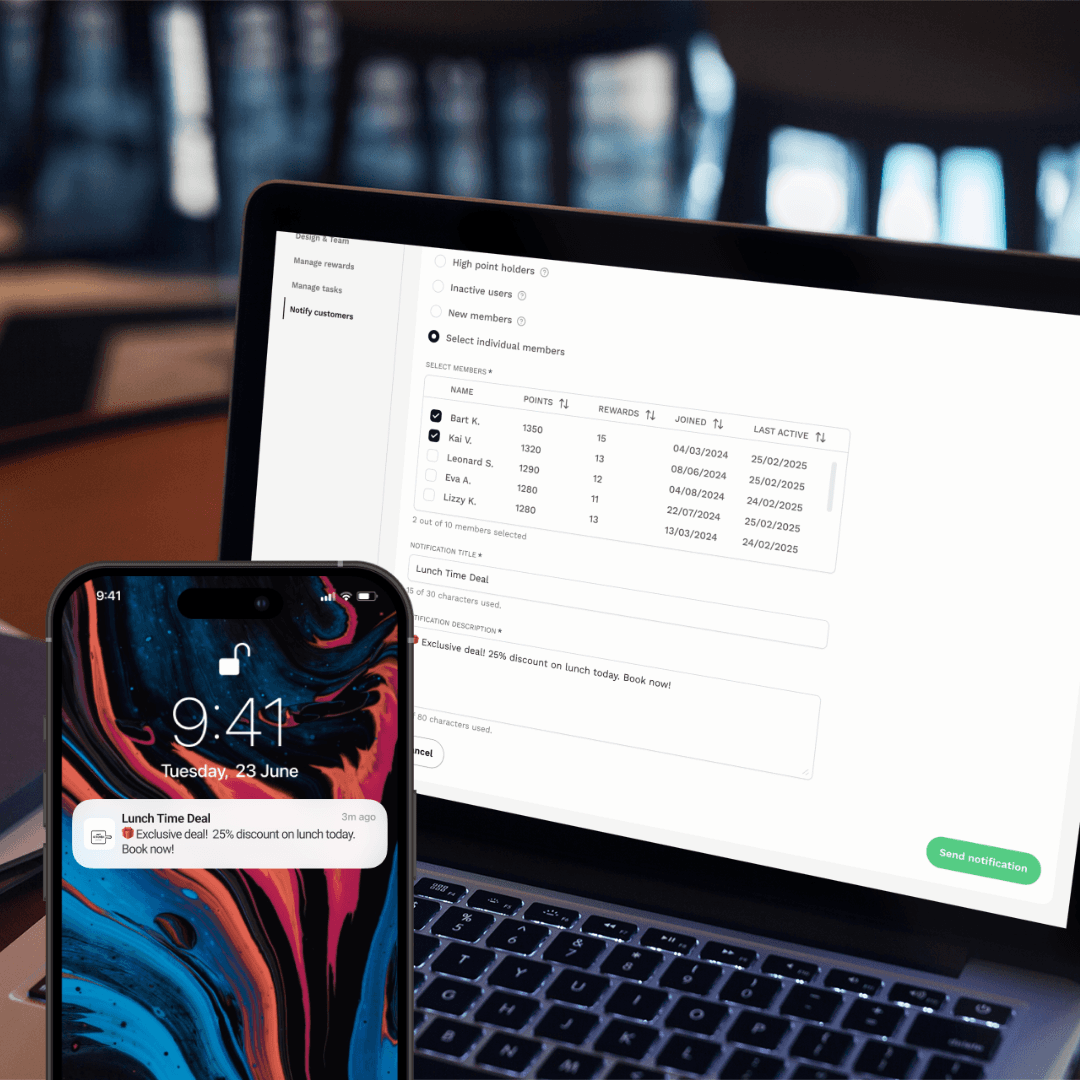
The customer receives an update through the branded app, wallet card, email, or push notification
Your team can track performance in analytics and adjust campaigns or rules
This is where API-first loyalty platforms stand out. They let you connect loyalty to the systems you already use, instead of forcing your business into a fixed workflow. A robust loyalty API is especially important when transaction, payment, or customer data needs to flow between multiple tools.
Features that matter most in card linking and white label loyalty platforms
Across the top-ranking content, the pattern is clear: the market cares most about branding, integrations, automation, analytics, scalability, and operational control. If you are comparing vendors, those are the areas that deserve the closest review.
Branding and white label customization
A true white label platform should support more than just a logo swap. Look for control over app branding, visual identity, copy, reward naming, customer messaging, and the overall user journey. If the provider offers a branded app published under your name in the App Store and Google Play, that usually signals a stronger white label model than a generic shared environment.
Loyalty mechanics and reward flexibility
The platform should support the loyalty structure that fits your business, whether that means points, vouchers, referrals, tiers, perks, wallet cards, promotions, or behavior-based incentives. Flexibility matters because a salon, sports club, clinic, and hospitality concept do not all reward the same actions.
API and integration options
Integration depth is critical. A useful loyalty platform should connect with the systems that already shape your customer journey, such as:
POS systems
Online booking tools
E-commerce platforms
Customer management systems
Email marketing tools
Customer data platforms
If your workflow is more complex, custom integrations can become just as important as native ones.
Automation and triggered engagement
Look for event-based messaging and workflow automation. Useful triggers include first visit, repeat purchase milestones, inactive members, tier upgrades, reward expiry, referrals, and off-peak incentives. This turns loyalty from a static program into an active retention engine.
Analytics and reporting
You should be able to measure member growth, repeat visit rate, redemption, reward usage, referral activity, campaign performance, and customer behavior over time. Reporting is not just for dashboards. It should help you decide which incentives actually change behavior.
Mobile and wallet experience
For many loyalty programs, mobile access is essential. Customers want quick visibility into points, rewards, and membership status. Wallet cards can also help keep the program visible without requiring users to search for an email or log in from scratch.
What to check if card linking is part of your requirements
The phrase card linking can mean slightly different things depending on the provider. Some platforms support direct payment-linked reward logic. Others create a connected experience through wallet cards, app identification, POS events, or transaction-sync integrations. That is why businesses should validate the exact model before choosing a platform.
Ask these questions during evaluation:
How does the platform identify a customer at purchase?
Does it rely on payment card linking, wallet cards, app membership ID, phone number, QR, POS sync, or another method?
Which transaction sources can trigger loyalty actions?
Can online and offline activity be combined into one member profile?
How are refunds, partial payments, and failed transactions handled?
What customer data is stored, and where does ownership sit?
Can the experience be fully branded end to end?
These questions matter because a platform can still be excellent for connected loyalty even if it does not market itself explicitly as a standalone card linking product. What matters most is the underlying customer recognition and reward logic.
How Authic fits into this landscape
Authic is relevant in this category because it offers a white-label loyalty platform with a branded loyalty app, loyalty API, wallet card support, and integrations with systems such as booking tools, e-commerce, customer management platforms, email marketing tools, POS systems, and customer data platforms. That makes it a strong fit for brands that want a connected loyalty setup under their own name.
It is important to be precise here: Authic publicly positions itself clearly around white label loyalty, branded apps, loyalty infrastructure, and integrations, but it does not appear to present card linking as a separate, explicit standalone product category on its site. So if your internal requirement is specifically payment-card-linked loyalty, you should confirm the exact implementation model with the team. If your goal is broader connected loyalty across app, wallet, POS, booking, and marketing flows, Authic is much easier to place in the category.
For businesses in sports, wellness, beauty, hospitality, and related service models, this can be especially useful because loyalty often depends on repeat visits, recurring bookings, and personalized communication rather than one-off transactions alone.
When a white label loyalty platform is a better choice than a generic rewards tool
A generic rewards tool can work if loyalty is a light add-on and your brand does not need much customization. But a white label loyalty platform is usually the better option when loyalty is part of your core retention strategy.
It tends to be the stronger choice when you need:
Your own branded app or customer-facing environment
Control over customer data and communications
Integration with your existing systems
Multiple loyalty mechanics beyond basic points
Scalability across locations, teams, or business units
Freedom to evolve the program over time
This is one reason white label loyalty software appears so often in competitive searches. Businesses are not only buying features. They are buying infrastructure that can support retention for years.
Use cases where connected loyalty can create measurable value
Sports and clubs
Reward attendance, referrals, off-peak bookings, event participation, and community engagement. Loyalty can help smooth demand and increase repeat activity among active members.
Beauty and wellness
Encourage repeat visits, treatment series completion, product add-ons, and member referrals. Automated reminders and tier incentives can increase visit frequency.
Hospitality
Connect loyalty to bookings, repeat stays, food and beverage spend, and promotional campaigns. A branded mobile experience can make perks more visible and easier to redeem.
Healthcare and clinics
Where appropriate and compliant, loyalty-adjacent engagement can support repeat services, retention, education, and communication. The main advantage is usually a better structured customer journey rather than discount-led tactics.
How to evaluate vendors without getting lost in feature lists
Long feature inventories can look impressive, but the best choice usually comes down to a smaller set of operational questions. Use the table below to compare platforms more clearly.
Evaluation area | What to look for | Why it matters
|
|---|---|---|
Branding | Fully branded app, wallet cards, messaging, and customer journey | Keeps loyalty native to your brand |
Integrations | POS, booking, e-commerce, CRM, email, CDP, API access | Reduces manual work and improves data quality |
Loyalty logic | Points, tiers, rewards, referrals, vouchers, triggers | Lets you match incentives to customer behavior |
Customer recognition | Card linking model, wallet card, QR, app ID, transaction sync | Determines how frictionless the experience feels |
Analytics | Retention, redemption, repeat visits, campaign performance | Shows whether the program changes behavior |
Scalability | Multi-location support, role management, extensibility | Prepares the program for growth |
Launch support | Onboarding, setup guidance, program design help | Improves speed and reduces implementation risk |
Common mistakes when choosing a platform
Assuming card linking means the same thing across all vendors
Choosing a platform based on front-end appearance alone
Ignoring integration depth until late in the process
Focusing on points while neglecting messaging and automation
Overlooking data ownership and reporting requirements
Selecting a tool that works today but cannot scale with your customer journey
Most loyalty issues appear after launch, not before it. That is why infrastructure decisions matter more than a polished demo alone. If you are comparing options, a practical white-label platform features checklist can help keep the review focused on the capabilities that actually affect delivery.
FAQ about card linking and white label loyalty platforms
What is a card linking loyalty platform?
A card linking loyalty platform connects a customer identifier to purchase activity so rewards can be applied with less manual effort. Depending on the provider, this may involve payment-linked logic, wallet cards, app identity, POS-linked events, or other transaction recognition methods.
What is a white label loyalty platform?
A white label loyalty platform gives you the underlying loyalty technology while allowing the customer-facing experience to remain fully branded as your own. That can include your app, visual identity, messaging, rewards, and communication flows.
Are card linking and white label loyalty platforms the same thing?
No. Card linking describes how customer purchases or actions are recognized for rewards. White label describes how the loyalty platform is branded and delivered. A platform can support one, the other, or both depending on its setup.
Why do businesses choose white label loyalty software over custom development?
Usually because it launches faster, costs less than building from scratch, and still offers strong control over branding, integrations, and loyalty logic. It is often the most practical balance between speed and flexibility.
Which integrations matter most for connected loyalty?
The most important ones are usually POS systems, booking platforms, e-commerce tools, CRM or customer management systems, email marketing tools, and customer data platforms. The right mix depends on how your customers buy and how your teams operate.
Can a loyalty platform work without a dedicated app?
Yes, but an app can improve visibility, engagement, and convenience. Some programs also use wallet cards, email, SMS, or web-based member areas. The best setup depends on how often customers interact with your brand and how much engagement you want to drive. Teams also sometimes compare mobile SDK vs web integration when deciding how loyalty should appear in the customer experience.
What should you ask a vendor if card linking is a priority?
Ask exactly how customer recognition works, which systems capture transactions, how rewards are triggered, how exceptions are handled, and whether the experience can be fully branded. This helps you separate true connected loyalty capabilities from vague product language.
Is Authic a fit for businesses looking at white label loyalty platforms?
Yes, especially if you want a branded loyalty app, wallet card support, integrations, and API-based flexibility. If you need a very specific payment-card-linked setup, you should confirm that implementation model directly, since Authic does not publicly frame card linking as a separate standalone product category. If you are still assessing partners, this is also a good stage to review how to choose a white-label loyalty provider.

Founder & CEO
Founder & CEO of Authic. Wouter helps businesses build lasting customer relationships through branded loyalty apps that drive engagement, repeat visits, and growth.

Continue reading



We provide the technology and simplicity to turn customers into loyal fans, without the complexity or cost of building it yourself.