Fast, no code setup
Increase sales on autopilot

A white label loyalty platform gives you the technology behind a loyalty program without forcing you to build the system yourself. You use a ready-made loyalty engine, then apply your own branding, rules, rewards, customer journeys, and integrations so the experience looks and feels like your brand, not a third-party app.
In practice, that means the platform handles the heavy lifting such as points ledgers, reward logic, customer identification, fraud checks, data handling, notifications, and reporting. You stay in control of the customer-facing experience. For businesses that want faster time to market, more ownership of customer data, and less custom development, this model is often the most efficient path to launching a branded loyalty program.
Below, you will see exactly how a white label loyalty program works, what happens behind the scenes, which components matter most, and how platforms like Authic help businesses launch quickly with their own branded loyalty app, campaign builder, loyalty API, and analytics.
What is a white label loyalty platform?
A white label loyalty platform is software that lets you launch and manage a loyalty program under your own brand. If you need a clearer introduction to what white-label loyalty software is, the core idea is that the platform provider supplies the underlying technology, while you control the branding, customer experience, reward structure, campaign setup, and communication.
Instead of building everything from scratch, you start with infrastructure that already supports core loyalty functions. These typically include points and tier logic, rewards, digital loyalty cards, customer accounts, notifications, referral flows, dashboards, and integrations with your existing tools.
The key difference between white label loyalty software and a generic third-party rewards app is ownership of the experience. Your customers interact with your branded environment. That can be a branded app, a branded web experience, or embedded loyalty journeys inside your existing digital touchpoints.
How the platform works from setup to customer action
At a high level, a white label rewards platform works in five stages: brand setup, program configuration, system integrations, customer activity tracking, and reward automation. Each step builds on the previous one.
You configure the brand experience, including logo, colors, content, tone of voice, and app or web presentation.
You define the loyalty mechanics, such as points, tiers, rewards, challenges, stamp cards, VIP cards, or leaderboards.
You connect the platform to your operational systems, such as booking flows, POS, e-commerce, CRM, or check-in tools.
Customer actions flow into the platform and are translated into loyalty events, for example a purchase, booking, visit, or referral.
The system automatically updates balances, unlocks rewards, triggers messages, and records data for analytics and optimization.
This is why many businesses ask, “how does a white label loyalty platform work?” The answer is not just “it gives points.” A modern platform acts as the logic layer between customer behavior and branded engagement.
The core building blocks behind a white label loyalty system
1. Branded front end
The front end is the part your customers see. In a white label setup, this is presented under your own brand. Depending on the platform, this may be a white-label app, mobile wallet experience, web portal, or embedded loyalty section within your existing app or site.
This layer includes visual branding, member account views, reward catalogs, points balances, tier status, digital cards, offers, and push or in-app messages. The goal is simple: customers should feel they are interacting with your business directly.
2. Loyalty engine
The loyalty engine is the rule system that decides how customers earn, progress, and redeem. It tracks actions and applies the logic you configure. For example:
Earn 1 point per purchase
Unlock a reward after 10 visits
Move members into a VIP tier after a spend threshold
Trigger a challenge for repeat visits within 30 days
Reward referrals, reviews, check-ins, or social actions
This engine is what makes loyalty feel dynamic instead of static. It connects business goals to measurable customer actions.
3. Customer data layer
A white label loyalty platform collects and structures customer activity data so the program can respond in real time. Typical inputs include bookings, purchases, profile attributes, redemptions, visit frequency, and campaign interactions.
This data layer is essential for personalization, reporting, segmentation, and lifecycle automation. It also helps answer practical questions such as who your best customers are, which rewards drive repeat visits, and where drop-off happens.
4. Integrations and API connections
The platform becomes much more powerful once it connects with the systems you already use. That is why API-first architecture is often a major feature in white label loyalty software.
With integrations, loyalty actions can happen automatically instead of being managed manually. If a customer books a class, checks in for an appointment, or completes a purchase, the platform can instantly award points or unlock rewards.
5. Automation and analytics
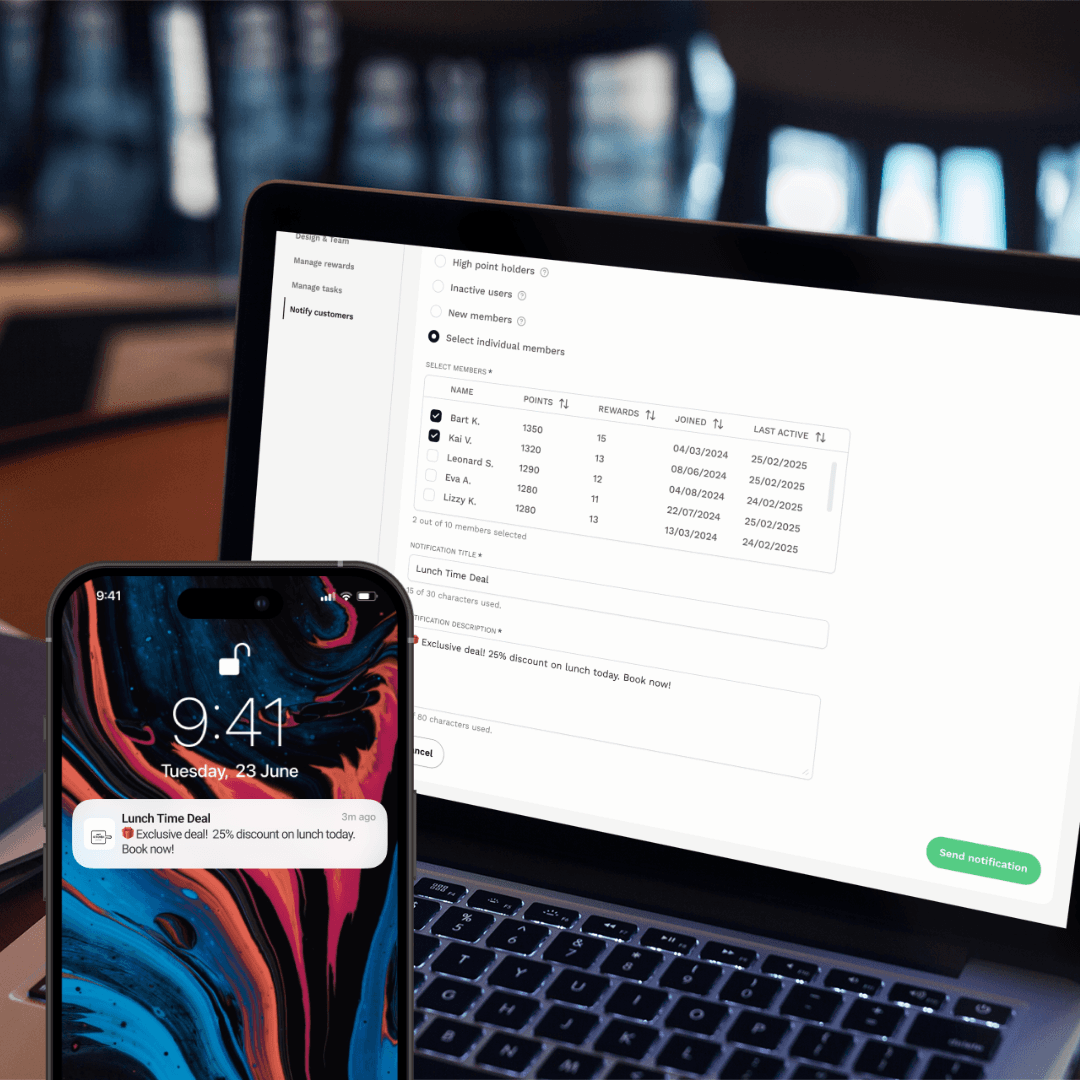
Modern platforms do more than store balances. They automate messages, campaign triggers, and reward flows based on behavior. They also provide analytics dashboards to show how the program performs over time.
This lets you improve retention, measure engagement, and optimize loyalty campaigns using real operational data instead of guesswork.
What happens behind the scenes when a customer uses it?
To understand how a white label loyalty program works in real terms, it helps to follow one customer action from start to finish.
Imagine a customer books an appointment through your app. The booking system sends that event to the loyalty platform through an API or native integration. The platform checks the rules you set. If the booking qualifies, the customer earns points. If they cross a threshold, they may unlock a reward or move into a new tier. The platform then updates the customer profile, records the transaction in the points ledger, and can trigger a notification telling the customer what they earned.
All of this happens in the background. The customer sees a simple branded experience. Your team sees the data, performance, and campaign results in the admin dashboard.
This is one of the biggest advantages of white label loyalty systems. The complexity is handled behind the scenes, while the experience stays seamless on the front end.
Which loyalty mechanics can you run on a white label platform?
Most modern white label loyalty platforms support multiple mechanics, not just points. That matters because different business models need different incentives.
Points programs - reward spend, visits, bookings, or specific actions
Tiered loyalty - unlock better benefits for higher-value members
Stamp cards - simple repeat-purchase mechanic for frequent visits
Challenges - encourage behavior within a timeframe
VIP cards - create premium access and exclusivity
Referrals - reward members for bringing in new customers
Leaderboards - add competition and community engagement
Triggered offers - send rewards based on inactivity, milestones, or lifecycle stage
Authic, for example, supports mechanics such as points, tiers, rewards, challenges, VIP cards, notifications, leaderboards, and stamp cards through its campaign builder. That gives businesses flexibility to match the program to their customer behavior and operating model.
Why businesses choose white label instead of building loyalty software from scratch
The strongest reason is speed. Building custom loyalty infrastructure means creating customer accounts, points logic, redemption flows, reporting, fraud protection, notifications, app experiences, and compliance processes from the ground up. That takes significant product, design, engineering, and maintenance resources.
With a white label platform, those foundations already exist. You configure the parts that need to be unique to your business, then launch much faster. According to Authic, many clients go live within 48 hours because the core technology is already in place.
There is also a control advantage. Compared with marketplace-style loyalty tools, a white label setup gives you more ownership over branding, communication, and customer journey design. That makes it easier to create a loyalty experience that feels native to your brand.
How integrations make the loyalty program actually useful
Without integrations, loyalty often becomes a disconnected marketing layer. With integrations, it becomes part of your daily operations. This is where many businesses move from a basic rewards idea to a system that supports retention at scale.
A well-integrated white label rewards platform can connect loyalty actions to real business events such as:
Purchases in-store or online
Bookings and reservations
Check-ins and attendance
Membership renewals
Referrals and promo code usage
CRM profile updates
Authic positions its platform as API-first and modular, which is important here. An API-first loyalty platform is designed to plug into the tools you already use, so points and rewards can be processed automatically for bookings, purchases, and check-ins. That reduces manual work and improves accuracy.
What data does a white label loyalty platform collect?
A white label loyalty platform usually collects the data needed to run the program, personalize engagement, and measure performance. The exact data depends on your setup, but it often includes:
Customer identity and profile data
Purchase or booking history
Visit frequency and recency
Points earned and redeemed
Reward usage
Campaign participation
Referral activity
Engagement with notifications or offers
This data helps you understand customer loyalty on a practical level. You can identify which segments are most active, which offers drive repeat behavior, and which members are at risk of dropping off. That is also why analytics is such a key part of any modern loyalty platform.
How analytics and automation improve retention
Once the program is live, the real value comes from optimization. Analytics show what is happening. Automation helps you act on it.
For example, if the data shows that customers who complete three visits in a month are much more likely to stay active, you can build a challenge around that behavior. If you see a drop in activity after a first purchase, you can trigger a reward reminder or comeback offer automatically.
Loyalty analytics typically help you track:
Member growth
Active vs inactive members
Reward redemption rate
Repeat purchase or repeat booking rate
Referral performance
Campaign participation
Revenue influenced by loyalty
Automation then turns those insights into action through notifications, lifecycle campaigns, and behavior-based incentives.
What makes a good white label loyalty platform?
If you are comparing options, the best platform is not just the one with the most features. It is the one that fits your business model and makes loyalty operationally easy to manage.
Look for these essentials:
True white label branding - your brand should remain front and center
Flexible campaign builder - you should be able to create points, tiers, challenges, and rewards without heavy development
API-first integrations - loyalty should connect to purchases, bookings, and customer systems
Analytics and reporting - you need visibility into performance and retention impact
Automation support - triggered campaigns and notifications should be built in
Scalability - the platform should work from one location to many
Privacy and compliance controls - especially for GDPR and customer data handling
Authic highlights several of these areas, including no-code setup, branded app delivery, loyalty analytics, campaign management, API connectivity, wallets, points ledgers, fraud checks, and GDPR-compliant data handling. If you are reviewing white-label loyalty platform features, these are the capabilities that matter most in practice.
White label loyalty platform example
Take a hospitality or wellness business that wants to increase repeat visits. Instead of building a custom loyalty app, the business launches a branded loyalty app through a white label platform. Customers download the app and see the business's branding, offers, and rewards.
The business sets up a program with points for bookings, bonus rewards for referrals, a tier for high-frequency customers, and a comeback campaign for inactive members. Through integrations, each booking automatically updates the member account. Customers receive points, track progress, and redeem rewards inside the app. The business monitors performance in the analytics dashboard and adjusts campaigns based on usage patterns.
That is the practical answer to “how does a white label loyalty platform work?” It works by combining branded customer experience, configurable loyalty rules, connected data, and automation into one system.
Who benefits most from a white label loyalty platform?
White label loyalty platforms are especially useful for businesses that need repeat engagement and want to keep the customer relationship inside their own brand. Common use cases include:
Restaurants, cafés, bars, and takeaway concepts
Beauty and wellness businesses such as salons and clinics
Sports and fitness brands, clubs, and courts
Multi-location operators that need a scalable loyalty setup
Businesses with bookings, memberships, or repeat visits
Authic specifically supports hospitality, beauty and wellness, and sports, with examples ranging from restaurants and coffee bars to salons, clubs, and clinics. These sectors benefit because loyalty can be tied directly to visits, bookings, referrals, and customer lifetime value.
FAQs about how a white label loyalty platform works
What is a white label loyalty program?
A white label loyalty program is a rewards or retention program that runs on third-party technology but appears under your own brand. Your customers interact with your branded app or experience, while the provider manages the underlying infrastructure.
How does a white label rewards platform differ from custom-built loyalty software?
Custom-built software is created from scratch for one business. A white label rewards platform provides the core system out of the box, then lets you customize branding, rules, and integrations. The main advantages are faster launch, lower development overhead, and easier maintenance. For a deeper comparison, see white-label vs custom-built.
How much does a white label app cost?
Pricing varies by provider, features, level of customization, and integration needs. Some platforms charge a monthly subscription, others use tiered plans or enterprise pricing. If you need app store publishing, API access, advanced analytics, or multi-location support, that can affect the final cost.
Can a white label loyalty platform support more than points?
Yes. Most modern platforms support a wider range of mechanics such as tiers, stamp cards, VIP access, challenges, referrals, leaderboards, and triggered rewards. This makes it easier to match the program to your goals and customer behavior.
What are the 3 R's of loyalty?
The 3 R's are often framed as Reward, Recognition, and Relevance. In platform terms, that means giving customers value, acknowledging their status or behavior, and making the experience feel timely and personalized.
What are the 4 C's of customer loyalty?
The 4 C's are commonly described as Customer experience, Consistency, Convenience, and Communication. A strong white label loyalty platform supports all four by keeping the experience branded, connected, easy to use, and data-driven.
Do I need a developer to launch a white label loyalty platform?
Not always. Many platforms offer no-code or low-code setup for branding and campaign configuration. More advanced integrations may still require technical support, but the goal of white label software is to reduce custom development significantly.
How long does it take to launch?
That depends on how much customization and integration you need. Simple setups can launch quickly, especially if the platform already supports your use case. Authic states that many clients go live within 48 hours. If you are planning rollout, an implementation guide can help clarify the steps involved.
Is customer data still controlled by my business?
In a true white label model, your business keeps control over the customer relationship, branded experience, and core program choices. Data governance still depends on the platform architecture and your agreement with the provider, so privacy, permissions, and compliance should always be checked carefully.
Why this model fits brands that want speed and control
A white label loyalty platform works by giving you the infrastructure of an advanced loyalty system without making you build every component yourself. You get the branded front end, loyalty logic, automation, analytics, and integrations needed to run customer retention in a structured way.
For businesses that want to launch quickly, connect loyalty to real customer actions, and keep the experience inside their own brand, this approach is often the most practical option. If you are evaluating vendors after learning the model, here is how to choose a white-label loyalty provider. Authic offers a white label app, campaign builder, loyalty API, and loyalty analytics designed to help businesses launch and scale branded loyalty with less friction.

Founder & CEO
Founder & CEO of Authic. Wouter helps businesses build lasting customer relationships through branded loyalty apps that drive engagement, repeat visits, and growth.

Continue reading



We provide the technology and simplicity to turn customers into loyal fans, without the complexity or cost of building it yourself.